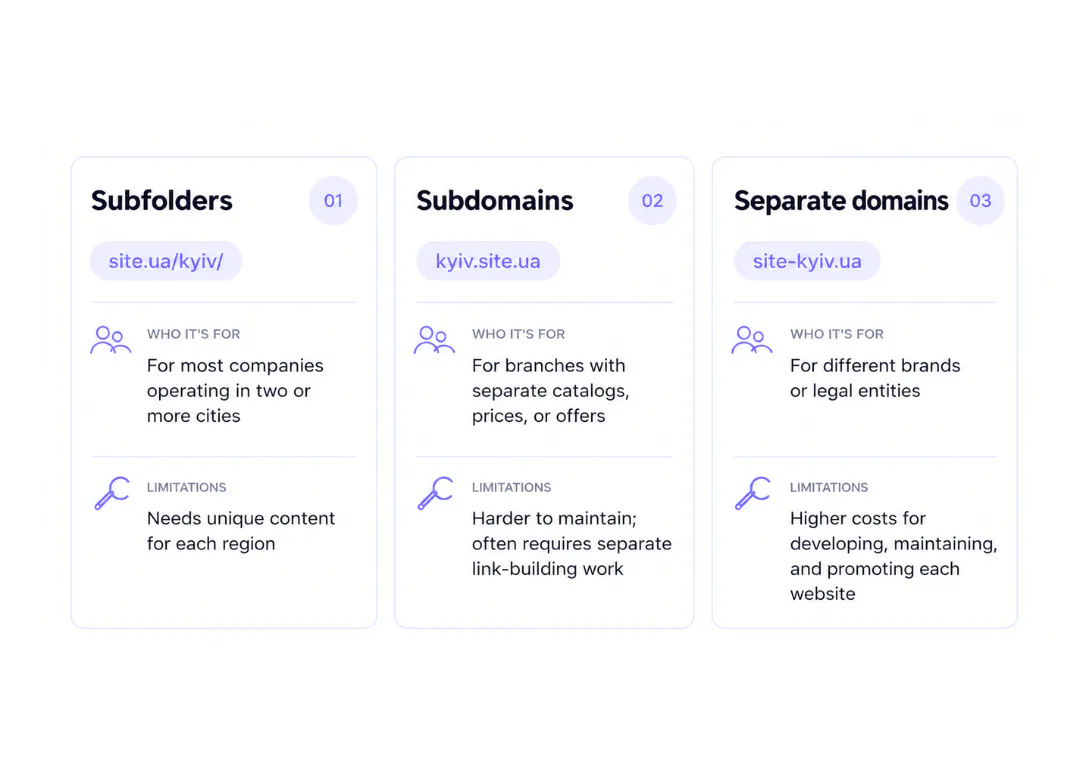
Regional SEO is essential for businesses that operate across several towns or regions and wish to attract customers from different local markets. Unlike promoting a single physical location, regional website promotion requires a separate strategy for each area.
A Google Business Profile listing alone is not enough. For regional website promotion to generate targeted enquiries, it is essential to organise the website’s structure correctly, target location-based searches and create useful pages tailored to the needs of residents in specific towns and cities.
How to create geo-pages that aren’t treated as duplicates
Regional optimisation on Google requires not only the correct URLs, but also substantive differences between pages.
For each city, we are working on:
- Content tailored to the actual search queries of the local audience, rather than simply replacing the name of the town in the text.
- The address and telephone number of the current branch, if any, or the actual delivery area or area covered by the call-out service.
- Local reviews, photographs of completed projects and case studies.
- Current prices, delivery times and terms of service, if these differ.
- LocalBusiness schema markup for the company’s actual physical locations.
- Internal linking between the main regional page, towns and logically related sections.
Which regions should we start with?
Promoting a website in a region begins with an assessment of search demand, potential profit margins and competition. First, we select the towns with the greatest commercial potential, then expand our reach as we see results. For example, to attract customers from Dnipro, you could create a separate landing page based on the principle of SEO in Dnipro.
When expanding into new geographical areas, it is important to take into account the specific characteristics of each market. For example, the page SEO in Odessa is focused on a specific city, for which it is necessary to analyse the relevant location-based search queries, the competitive landscape and the needs of the local audience.
A similar approach is used when creating pages for other cities, for example SEO in Lviv. However, simply creating dozens of copies with the city name replaced does not constitute a comprehensive regional strategy. Each location-specific page must address a specific search intent, contain accurate information about services in the region, and help the user place an order.