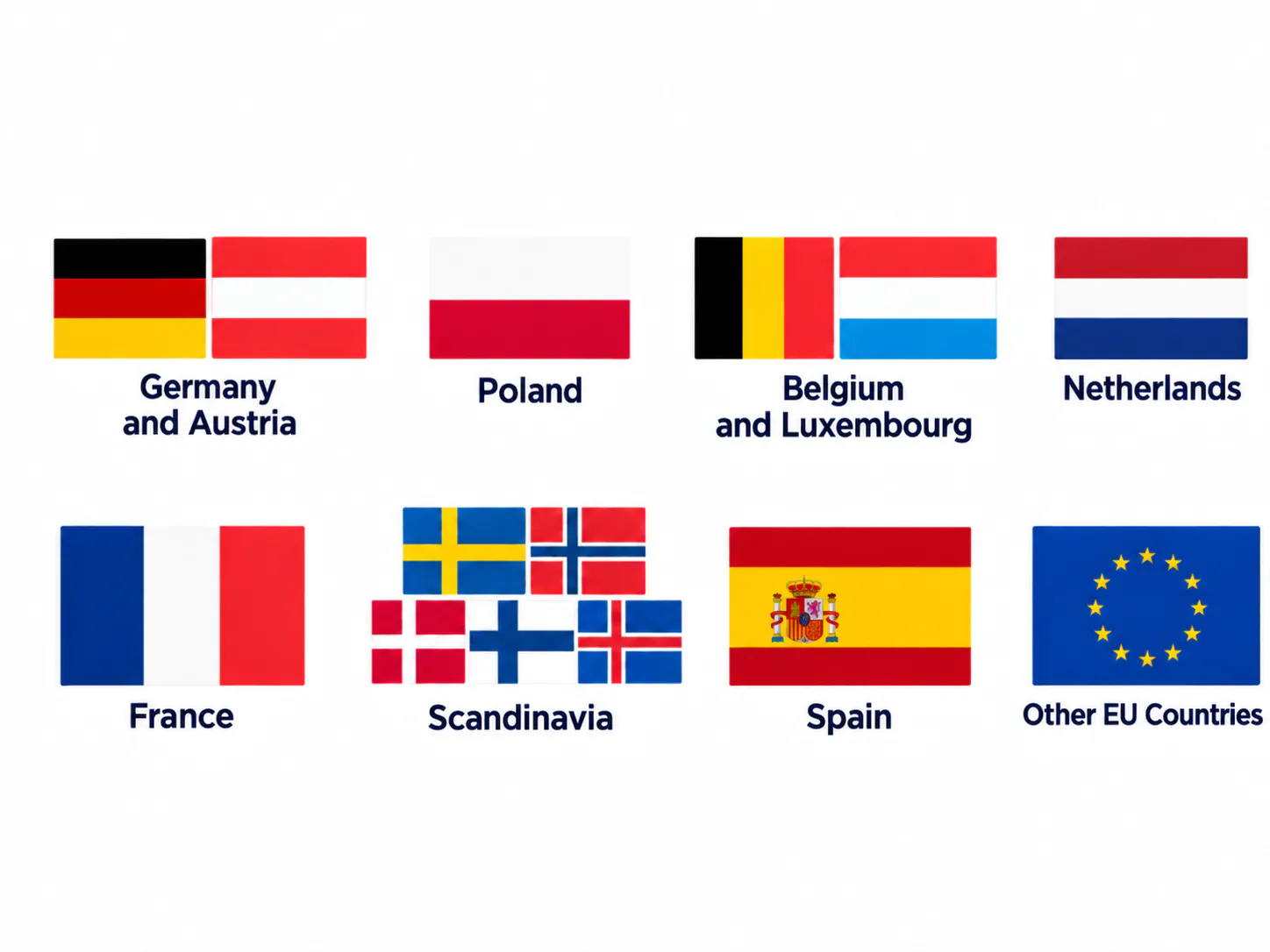
European markets we work with
SEO promotion for Europe: country-level keyword research across the EU, multilingual versions and hreflang, content localization. The image shows the markets in which we have experience working.
We get websites ranking country by country across the EU — with the right language, demand data and local requirements
Europe is close to thirty separate search markets. Each one has its own language, its own competitors and its own search habits. We build keyword research for a specific country and separate your language versions so they stop taking rankings from each other.

Every EU country is a separate set of search results, with its own language and its own list of competitors. One shared version of a site rarely works in any of them.

Pages in different languages cannibalize each other in search: hreflang is either misconfigured or missing entirely.

Google serves it to the wrong region, while in the target country there are no rankings at all.

Currency, delivery times, price formats and selling points do not match what a local buyer expects.

Budget is spread across several markets at once, and none of them shows a noticeable result.

Placements on generic or irrelevant sites do nothing for rankings in the local search results.

No proper cookie banner, company details buried. For a European audience that undercuts trust immediately.
01
We develop the pages and queries that bring enquiries from markets where you actually have a product and can deliver.
02
Pages stop competing with one another, and each version reaches the audience it was written for.
03
Localized content, local currency and clear terms remove the «this is a foreign company» barrier.
04
You can see which country brings enquiries and which one only spends budget.
A customer acquisition channel from Google that works across your chosen EU countries and scales from one market to the next.
01
We assess demand, competition and purchasing power market by market, then suggest starting where results come faster.
02
We check indexing, speed, the mobile version and the signals Google uses to decide which region a page belongs to.
03
We pick the structure — subfolders, subdomains or separate domains — and configure hreflang and canonicals so versions stop competing.
04
Queries come from the local language rather than translation: wording, terminology and commercial modifiers differ in every country.
05
We adapt pages to the language, currency and local terms, and earn mentions on industry resources in the target country.
06
Rankings, traffic and conversions are tracked separately for each country, and budget shifts toward the ones producing enquiries.
SEO promotion for Europe: country-level keyword research across the EU, multilingual versions and hreflang, content localization. The image shows the markets in which we have experience working.
A company from the United States approached us with the goal of increasing organic traffic. At the start of the project, the website was being migrated to a new domain, so we prepared technical requirements and provided SEO support for the migration. We also optimized the commercial pages and systematically built backlinks. Over two years, the average number of users grew from 50 to 400 per day, and the website generated approximately 200 conversions.
View case≈ 200
Conversions
↑ 800%
Average number of users per day
ТОП-10
By specific queries

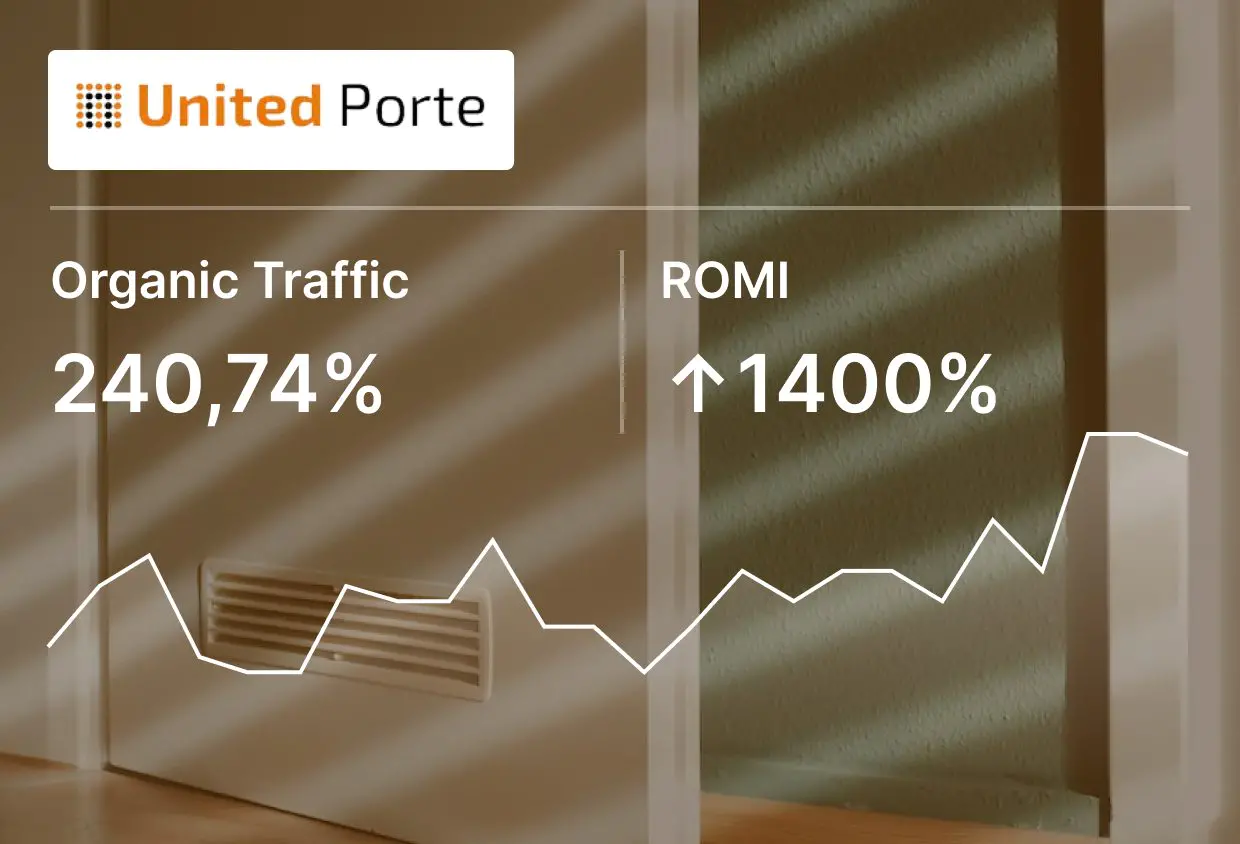
The door manufacturer United Porte approached us with the goal of improving the visibility of its online store on Google and increasing the number of conversions from organic traffic. We expanded the site’s structure, fixed technical errors, launched a blog, and strengthened the backlink profile. From January 2022 to July 2023, organic traffic grew by 240.74%, and ROMI reached 1,400%.
View case1400%
ROMI Promotion
↑ 240%
Organic traffic
↑ 20%
Conversions
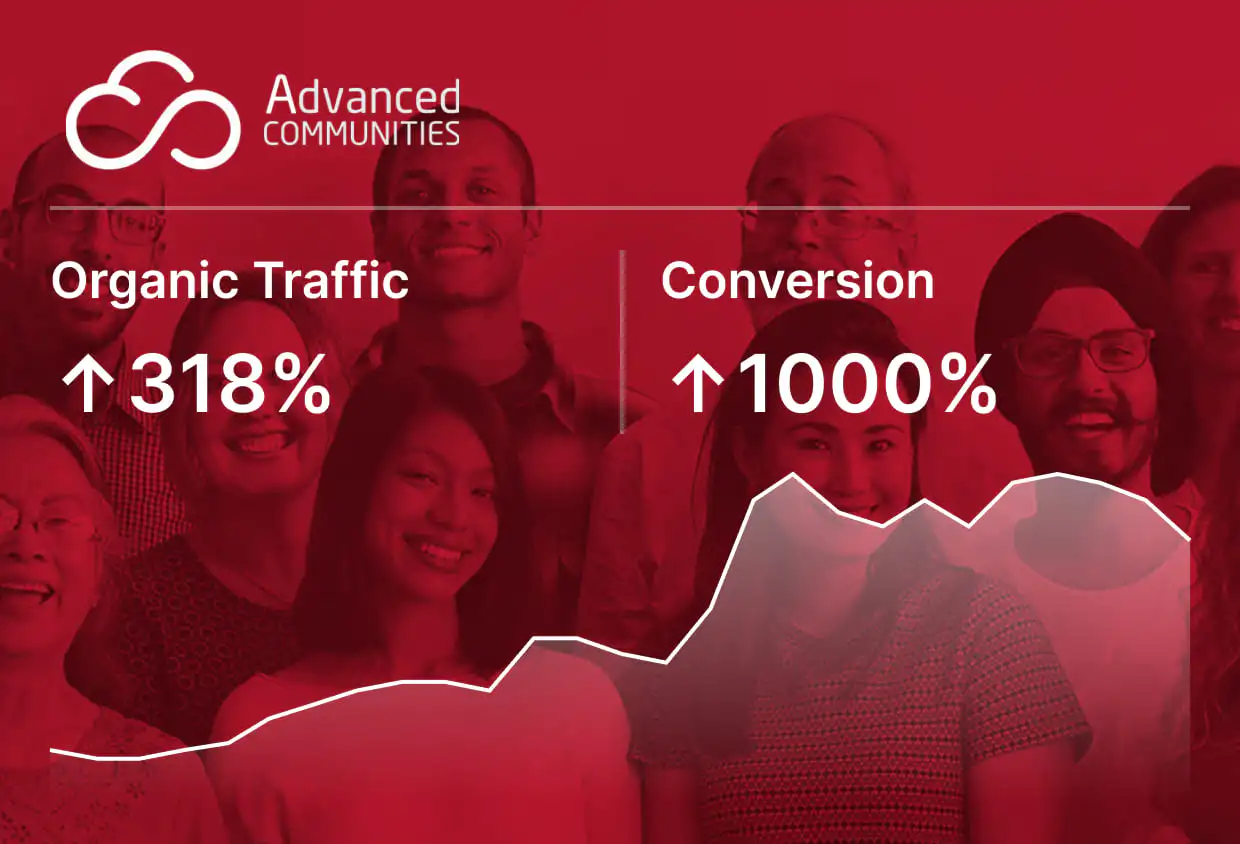
The IT company Advanced Communities needed to increase organic traffic from the U.S. and the U.K. and boost the number of organic conversions. We performed technical optimization, expanded the site’s structure based on semantics, and launched a blog. Over the course of 2 years and 2 months, organic traffic increased fivefold, and the number of goals achieved rose by 1,185%.
View case↑ 1185%
Goals Achieved
↑ 207%
Conversion Rate
↑ 65%
Page Depth
I am extremely satisfied with the work this SEO company has done! Working with them has been an outstanding experience. They’ve done an excellent job promoting my website, which has led to a significant increase in traffic and conversions. The team at this company has demonstrated a high level of professionalism and dedication in every aspect of the project. They thoroughly analyzed the competition, optimized the content, and ran successful link-building campaigns. They’ve always been responsive, ready to answer my questions and provide recommendations...

Awesome company, thank you very much for your cooperation. They helped us with SEO promotion and brought many key queries to the TOP-3. They helped with setting up contextual advertising, which also gave great results! I recommend them!

We have been working with Idea Digital Agency for almost 10 years now, and it is a partnership that we truly value. Throughout this time, the team has consistently demonstrated a high level of professionalism, responsibility, and a deep understanding of digital marketing. It is always a pleasure to work with specialists who not only do their job well but also offer fresh ideas, creative solutions, and genuinely care about the outcome. We want to highlight their openness in communication and efficiency in resolving any issues. We sincerely recommend Idea Digital Agency as a reliable and strong digital partner!

They are a great team. They developed a website for our company and are engaged in promotion. We are always satisfied with the work. Prompt, efficient and professional. They listen to the client, give the necessary recommendations, and really estimate the cost of their work.

Thanks to Idea Digital Agency, website traffic increased by 20% per month. The team completed the project on time and facilitated a smooth project management process. Their team is focused on results and profitable cooperation.

A team of professionals, always in touch, we cooperate in SEO, I am satisfied with the work, I see results, I like the flexible approach, the right pricing policy, and the people are pleasant to communicate with. I can see that the owners are building a company for many years, they value customers and reputation. I recommend it to everyone who is looking for a reliable partner.

We work with companies selling in EU countries and adjust the approach to the number of markets and languages involved.
Platforms and services with European users. We handle product keyword research in several languages plus expert content.

Stores selling in Europe. We localize the catalogue, categories and product pages, and account for currency and local delivery terms.
B2B and service companies: commercial pages per country, local search, reputation and industry visibility.

We build the strategy from scratch: priority countries, language architecture, localization and link profile.
The price depends on how many countries and languages are involved, competition in your niche, the condition of the site and the amount of localization needed. As a guide: from $450 for a one-off audit with market analysis, from $1,500 per month for systematic work on a single priority market, and from $2,500 when promoting in several countries at once. We quote the exact figure after an express review.
Mainly multilingual setups and the separation of markets. Each country needs its own keyword research, language versions and hreflang have to be configured correctly, content must be localized for local currency and terms, and links should come from resources in the target country. On top of that come EU requirements on data processing and company transparency.
The one where demand for your product already exists and where competition still allows results in a reasonable timeframe. We assess markets by search volume, competition level and purchasing power, then suggest taking one or two and scaling from there.
No, and more often than not that is a mistake. Translating into five languages without localization and without link support simply spreads the budget thin. It is cheaper and faster to launch one market properly, get a result and add the next ones.
Through correct architecture and hreflang. We choose the structure that fits the task — subfolders, subdomains or separate domains — and set up the relationships between versions so Google serves the right page to the right audience instead of letting them compete.
The first movement in rankings is usually visible within 3 – 6 months; a steady flow of enquiries more often from 12 months. On less competitive EU markets results can appear sooner than in the US or the UK.
Send us a request and we will show you what stops the site from gaining traffic in your chosen country: technical errors, conflicts between language versions, weak metadata and gaps in localization. Important: This is an express check to scope the work, not a replacement for a full technical audit.
SEO promotion in Europe differs from work on any single market because Europe as one market does not exist. It is several dozen countries, each with its own language, search habits, competitors and legal requirements. A site that ranks well in Poland can be completely invisible in the Netherlands, even when the content has formally been translated.
That is why website promotion in Europe starts with choosing priority countries rather than with translation. We look at demand volume, competition level and the purchasing power of the audience, work out where results are achievable sooner, and build the strategy from one market to the next. Measurable results arrive noticeably earlier this way than when trying to cover the whole EU at once.
The first thing to deal with is multilingual structure. Until hreflang and canonicals are in place, language versions start competing with each other. This is the single most common technical reason a site translated into five languages ranks on none of its markets.
The second is the depth of localization. Local currency, price formats, delivery and returns terms, familiar payment methods, even the structure of a commercial offer all differ from country to country. Translation does not solve that.
The third is EU requirements on personal data and company transparency. A proper cookie banner, a clear privacy policy and accessible legal entity details affect both audience trust and how a search engine reads the site.
SEO optimization in Europe starts with the architecture of language and regional versions. We choose the structure — subfolders, subdomains or separate domains — based on the number of markets, the team’s resources and development plans. Then we configure hreflang, canonicals and regional signals so Google serves the right version to the right audience.
The rest of the technical work is standard in scope but critical in execution: loading speed, the mobile version, correct indexing, removing duplicates, a clean structure. SEO for European markets does not work without that base — on competitive markets technical errors cost more than they do locally.
Smaller European markets often turn out more profitable than large ones: competition is lower while the audience has high purchasing power. Website promotion in Belgium is complicated by the country being multilingual itself. Flanders searches in Dutch, Wallonia in French, the eastern cantons in German. A single language version covers only part of the demand, so we split keyword research and content by language community.
Website promotion in Luxembourg follows similar logic: the business environment runs on French and German, while a substantial share of the audience are English-speaking professionals at international companies. The market is small in volume but carries a high customer value, so even modest traffic can pay back well. We apply the same approach to the Netherlands, Germany, Austria, Poland, France, Spain and the Scandinavian countries.
The cost of website promotion in Europe depends on the number of countries and language versions, competition in the niche, the current state of the site and the volume of localization. A one-off audit with market analysis starts from $450, systematic work on one priority market from $1,500 per month, and simultaneous promotion across several countries from $2,500. The budget for external links is calculated separately.
The strongest influence on the final figure is the number of languages. Every additional version means separate keyword research, separate content and a separate link profile — effectively a separate project. That is why we almost always recommend starting with one market: it costs less, produces results sooner, and lets you test the hypothesis before scaling.
Organic search and paid traffic work well together in Europe. Google Ads quickly shows which queries and offers convert on a specific market, and SEO turns those findings into a long-term channel with no ongoing cost per click. When entering a new country, that combination shortens the time to the first enquiries.
If only paid traffic interests you, take a look at our separate contextual advertising service, which covers formats, process and budgets. For most projects we recommend running both channels, with the priority between them depending on the stage and the goals.
International SEO promotion
We help you attract customers from Google in the US, the UK, Canada and the EU. SEO for non-English websites includes localisation, technical optimisation, content and a growth strategy tailored to the specific market.
Link Building
Backlink growth guided by strategy: we review the current profile, analyse competitors, select relevant donors and control the anchors. You see where the links are placed, why they are needed and how the key SEO metrics change.
Google Ads Advertising
We set up paid search for your goals: search, the Display Network, remarketing. The advertising budget stays in your account and under your control.
Leave a request and we will contact you.
Тариф «»
Ready to discuss your project?
Leave a request and we will contact you.