What Is an Anchor List and How to Create It Correctly?

An anchor list is a list of link texts (anchors) used for a website’s internal and external links. It helps search engines understand a page’s topic and assess the relevance of the backlink profile.
A well-crafted anchor list is an important part of an SEO strategy. It helps structure link-building efforts, make the backlink profile appear more natural, and improve search engines’ understanding of page content.
An anchor text is the text that a user clicks on to navigate to another page. It is this text that provides additional context about the content of the page the link leads to.
Anchor text on a page provides search engine crawlers with valuable context, helping them better understand the relevance of your website’s pages to specific search queries. In this article, we’ll take a detailed look at the concept of an anchor list, its classification, its role in website SEO optimization, and practical tips for compiling a relevant anchor list.
What is an anchor list
An anchor list is a list of texts (anchors) used for external and internal links on your site. An anchor link — is the text that a user clicks on to go to the target page. This text provides search engines with contextual information about the content of the page to which this link leads.
This is what an anchor looks like among regular text – as a rule, the anchor text is highlighted in a different color.
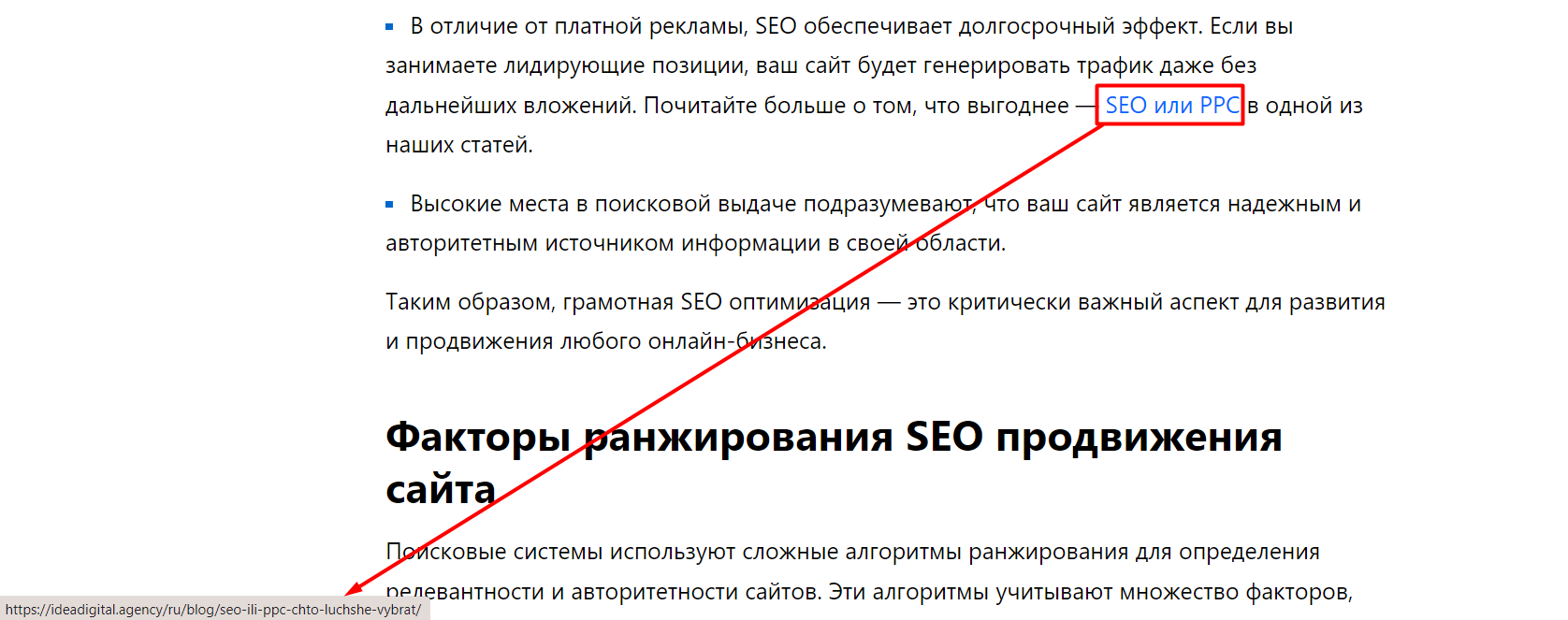
High-quality SEO site promotion cannot be done without compiling an anchor list, since search engines, such as Google, use anchor texts to determine the relevance of a page to certain keywords and phrases. Anchor texts play an important role in SEO because they help search engines understand what the page they are linking to is about. For example, if page A contains a link with the anchor “buy a laptop” pointing to page B, the search engine interprets this as a signal that page B is relevant to the query “buy a laptop”.
An anchor list should contain all types of anchor texts used on and off the site (meaning off-site optimization). It allows you to structure your link promotion and ensure that the links look natural and are useful to users.
When working with anchors, you should consider many important factors. Below we will talk about the main aspects, but often to the basics you need to add an understanding of the nuances of the niche and the site itself. That is why it is so important to involve professionals in the work. Idea Digital Agency is a digital agency in Kyiv, which employs a team of professionals with experience in working in different niches and with different sites. Contact us if you want to get the most out of your site.
Anchor Classification
Anchors can be divided into several types:
Direct keyword insertion — an anchor that contains a keyword or phrase in exact match.
Mixed anchors— an anchor that contains a keyword in combination with other words.
Anchorless links — links that use navigational words like “here,” “read more,” or just a URL instead of keywords.
Branded anchors are anchors that contain a brand name.
Image anchors are links that are linked to images. In this case, the image anchor is the alt attribute of the image.
The role of anchor text in SEO
A good anchor text plays an important role in a successful SEO strategy:
Anchor texts provide search engines with contextual information about the content of the page to which the link leads. This helps search engines better understand the relevance of a page to certain keywords and phrases.
Properly optimized anchor links can help your site rank higher in search results for relevant queries.
Well-chosen anchor texts make links more understandable and attractive to users, increasing the likelihood of them clicking through to your site.
Anchor links from high-quality and reputable donors can increase your site’s authority in the eyes of search engines.
Properly used anchor text helps link pages on your site to each other, making navigation easier for users and search engines.
How to create the right anchor list
When creating anchor lists, you should consider a number of important factors. Here are some steps that will help you when working on anchors for your site.
Define your goal and audience
First of all, it is important to clearly define the goal of your SEO strategy and target audience. This will help you choose the right keywords and phrases, and ensure that your anchor texts are relevant to your audience. Answer the following questions:
What goal do you want to achieve with SEO?
Who is your target audience?
What keywords and phrases are most relevant to your business?
The answers will help you responsibly approach the selection of anchors that will be effective and useful for your site.
Collect a semantic core
A semantic core is a list of keywords and phrases that you plan to use to promote your site. It should include:
Main keywords
Synonyms and variations of keywords
Long-tail keywords
You can use various tools to build a semantic core, such as Google Keyword Planner, Ahrefs, SEMrush, and others. It is important to consider not only popular keywords but also low-frequency queries that can bring targeted traffic.
Analyze your competitors
Off-page optimization starts with deep research of your competitors — to study their link profiles. Analyzing your competitors’ link mass and anchor lists will help you understand which anchors work in your niche. Use special tools to analyze your competitors’ link mass and their anchors: Ahrefs, SemRush, Majestic, or others. It is important to pay attention to the following aspects:
what keywords are used in anchors
how anchors are distributed by type
on which sites are links with these anchors placed
Analysis of backlinks and anchors will help you create a strategy based on the successful examples of your competitors. As a result, you will be able to create an internal anchor list that will be as effective as possible.
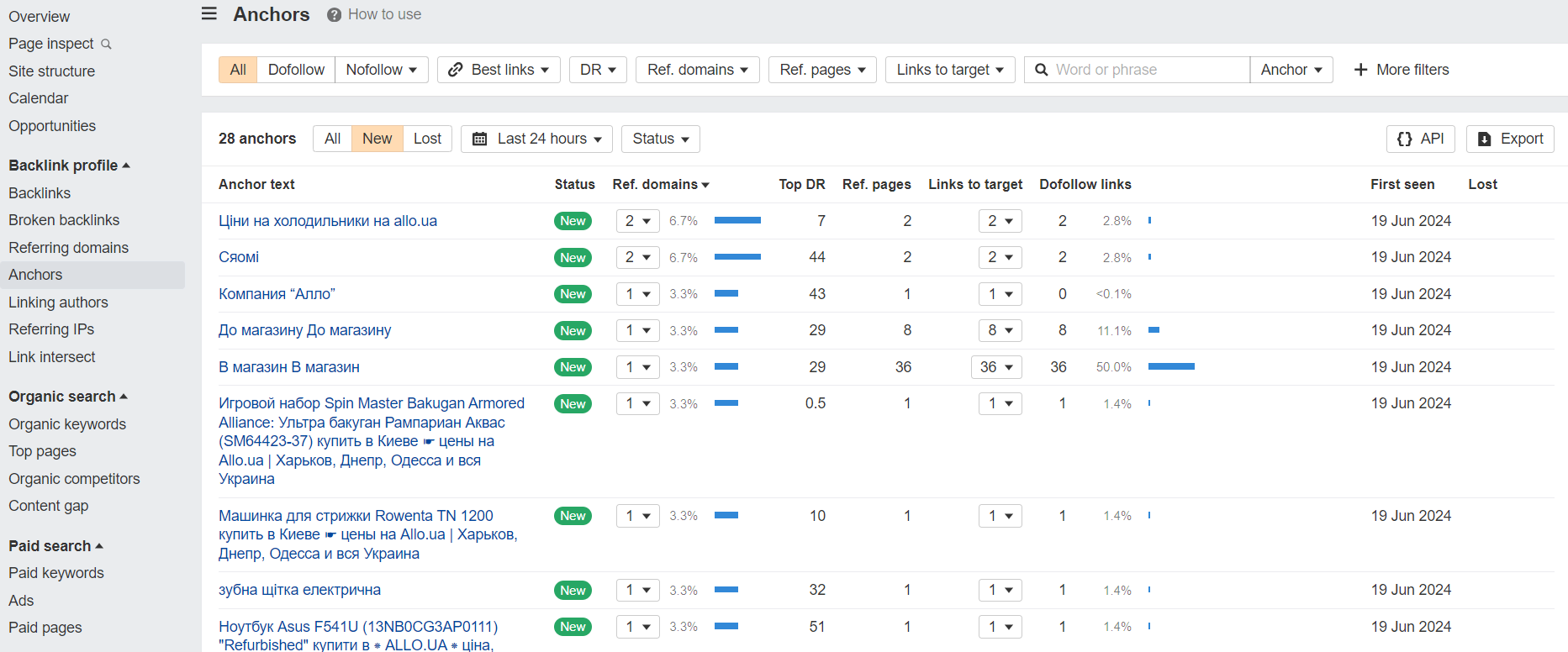
For example, this is what the anchors that Allo has recently used to place on external resources look like – the list was obtained using the Ahrefs tool.
Distribute anchor texts by types
After collecting the semantic core and analyzing competitors, it is important to distribute anchor texts by type. This will help create a balanced and diverse anchor list for the site that looks natural to search engines and users. It’s best to use a variety of anchor types, including exact keyword matches, partial matches, branded keywords, and natural anchors.
Determine the optimal ratio of anchor types
There is no ideal ratio of anchor types that works for all sites and industries. You need to study the niche, as well as conduct SEO analysis of competitors, and make personalized conclusions about the type and number of anchors to achieve the best results. Pay special attention to branded anchors – they can increase your brand visibility and trust.
Avoid keyword spamming
While using keywords in your anchor text is important, overusing them can be seen as spam by search engines and result in a decrease in your site’s ranking. When choosing your anchor text, avoid overusing the same exact match keywords. Instead, aim for variety and naturalness.
Update your anchor text regularly
Google’s algorithms are constantly evolving, and what worked before may become ineffective over time. That’s why it’s important to regularly update and optimize your anchor text. Keep an eye on changes in search trends, and competitors, and adapt your anchor list accordingly.
How many anchor and non-anchor links to use
In the SEO world, it is common to use anchor and non-anchor links in a certain ratio. Balance is important for a natural link profile. The following ratio is recommended:
Anchor links – 60-70%
No-anchor links – 30-40%
This balance helps create a natural link profile that meets the requirements of search engines and improves the site’s ranking. In addition, it is important to consider that excessive use of anchor links can arouse suspicion in search engines and lead to sanctions.
Regular monitoring and analysis of the link profile help to timely detect and correct possible deviations from the optimal ratio.
Conclusions
Creating anchor text links is an important step in developing an SEO strategy.
A properly compiled and regularly updated list of anchor text links helps improve a website’s visibility in search engines, build a strong backlink profile, and ensure user-friendly navigation.
By following the recommendations outlined in this article, you can create an effective list of anchor text that will help make your link-building efforts more structured and effective.
However, it’s important to keep in mind that these are basic recommendations. When developing a strategy, you need to analyze the specifics of your project, your business niche, your competitors, and your website’s current backlink profile.
If you’d like to entrust this work to experts, turnkey link building service from our agency.
It’s also important to keep track of changes in search engine algorithms and adapt your promotion strategy accordingly.
Link quality and anchor text relevance play a crucial role in building an effective backlink profile.
Regular audits and adjustments will help keep your promotion strategy up to date and ensure it meets search engine requirements.
Would you like your product to generate SEO traffic and attract customers on its own?
Submit a request — the Idea Digital Agency team will conduct an audit of your website within 48 hours, prepare recommendations, and discuss a future marketing strategy.
FAQ
An anchor list is a list of link texts used for a website’s on-page and off-page optimization. It helps search engines understand the topic of pages and assess how natural the backlink profile is.
An anchor list is needed to manage a website’s link-building strategy. It helps distribute anchors, control the use of key phrases, and create a more natural backlink profile.
The main types of anchors are exact-match keyword anchors, partial-match anchors, branded anchors, and non-anchor links. They are used in different proportions to make a backlink profile look natural.
When creating an anchor list, you need to consider the website’s topic, the pages being promoted, target search queries, the specifics of the niche, and competitors’ backlink profiles. It is important to use different types of anchors and avoid excessive repetition of the same phrases
There is no universal ratio of anchor to non-anchor links. The optimal distribution depends on the website’s topic, competition in the niche, and the characteristics of its current backlink profile.
Yes. Excessive use of the same commercial anchors can look unnatural and create a risk of over-optimization. That is why it is important to analyze the backlink profile regularly and adjust the strategy.



Ready to discuss your project?
Leave a request and we will contact you.