
Key Takeaways
- An FAQ is a structured section of questions and answers that helps both users and AI search quickly find the information they need.
- Modern SEO requires a shift from a list of keywords to well-thought-out, context-rich content tailored to different search intents.
- FAQs cover low-frequency and conversational queries, increasing the chances of appearing in AI-generated answers and summaries.
- Real-world questions should be gathered from search suggestions, analytics tools, and customer feedback.
- Answers should be short, clear, and informative — ideally 40-80 words for simple questions and up to 150 for complex ones.
- FAQ Schema and structured data help search engines recognize a block of questions, but this isn’t enough without high-quality content.
- Mistakes in FAQs — such as overly general questions, long or repetitive answers, or a lack of expertise — reduce effectiveness in AI search.
Users increasingly receive answers not from classic search results, but via AI Search, AI Overviews, chatbots, and generative search. Search engines are actively leveraging artificial intelligence to process queries, extracting concise, precise answers from pages. In this context, FAQ content sets new rules, becoming not just a block of questions and answers for users, but a key element for new algorithms.
Do search engines really learn not only to find pages but also to generate answers based on structured data that AI understands best? And is FAQ content today a sort of bridge between websites and AI-powered search? Let’s explore this together.
What is FAQ and why has it become important again
FAQ (Frequently Asked Questions) is a block or page containing common questions with brief answers. Originally, FAQ pages were created for user convenience — to quickly resolve popular issues. Later, such content became a standard part of SEO site promotion, improving internal linking and enhancing page relevance.
Today, the FAQ’s role goes beyond user convenience. AI-powered search demands clear structure and precise data formatting from websites. FAQ content becomes the format AI systems recognize as ready-made semantic blocks with a question and an exact answer. This significantly assists AI in delivering answers, helping sites appear in AI Overviews and other new result formats.
This trend is confirmed by the rising popularity of FAQ Schema markup, which highlights structured FAQ data and increases the chances of appearing in attractive rich snippets.
How AI Search changes SEO content requirements
Traditional SEO, where keyword choice and density were paramount, is gradually becoming secondary. Today, it’s vital not just to rank for a query, but to be maximally understandable to AI systems that analyze meaning, context, and logic — not just keywords.
From keywords to semantic blocks
AI has learned to grasp context deeply, evaluating not only the exact keyword but also related entities, logical connections, and completeness of topic coverage. For example, if a query concerns FAQ schema markup, AI assesses how expertly the topic is covered: what FAQ schema is, how to implement it, common mistakes when using it.
Why AI prefers structured content
Structured blocks — lists, definitions, concise summaries — help AI extract relevant information efficiently. FAQ blocks, with clear question-answer separation, perfectly illustrate this. Using FAQ structured data allows AI to quickly find and correctly interpret information, increasing the odds of appearing in AI Overview and chatbots.
Why FAQ is essential for AI Search
FAQ is not just an auxiliary section. It plays a vital role in how your site interacts with AI search by:
- Covering low-frequency queries. Many AI queries are long, conversational, and hard to optimize traditionally. FAQs with carefully chosen questions address such specific queries, creating a knowledge base for AI.
- Increasing chances of citation in AI answers. Short, accurate, expert responses are convenient for use in generative answers and AI Overview summaries. FAQ Schema allows these answers to appear directly in rich snippets and voice responses.
- Boosting topical expertise of the page. FAQ complements the main article, demonstrating deeper topic coverage, increasing trust for both users and algorithms.
Which questions to include in an FAQ for AI Ranking
Questions from search suggestions and People Also Ask
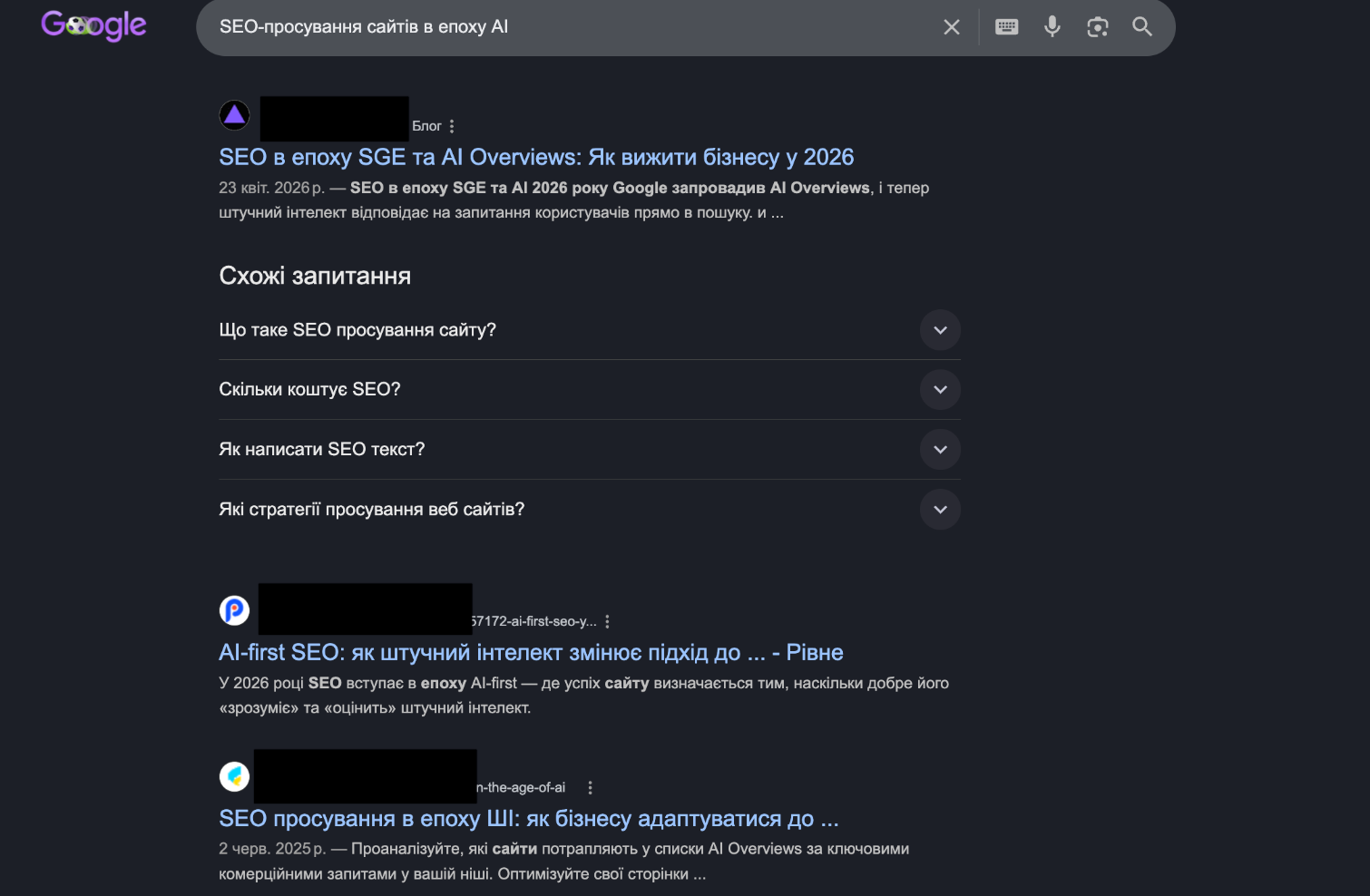
Collect questions from Google Suggest, «People Also Ask» blocks, Search Console tools, competitor analysis, and direct feedback from sales and customer support. This helps craft an FAQ that thoroughly addresses real queries and doubts of your audience.
Questions that address user doubts
Include questions that remove barriers, such as «Why have FAQs?», «How do FAQs affect SEO?», «Do FAQs help get into AI answers?». Such questions motivate and persuade users at different decision-making stages.
Questions for different funnel stages
Design FAQs considering various buyer funnel stages:
- Informational — general topic questions.
- Comparative — differences and advantages.
- Commercial — pricing and terms.
- Clarifying — details, examples, technical points.
How to write FAQ answers that AI systems understand
FAQ content should be user-friendly and AI-friendly — AI analyzes content structure, answer clarity, and concept connections. The clearer and more logical the questions and answers, the higher the chance search algorithms and language models will accurately interpret and use the information in their responses. Key principles for creating FAQ content well-received by AI:
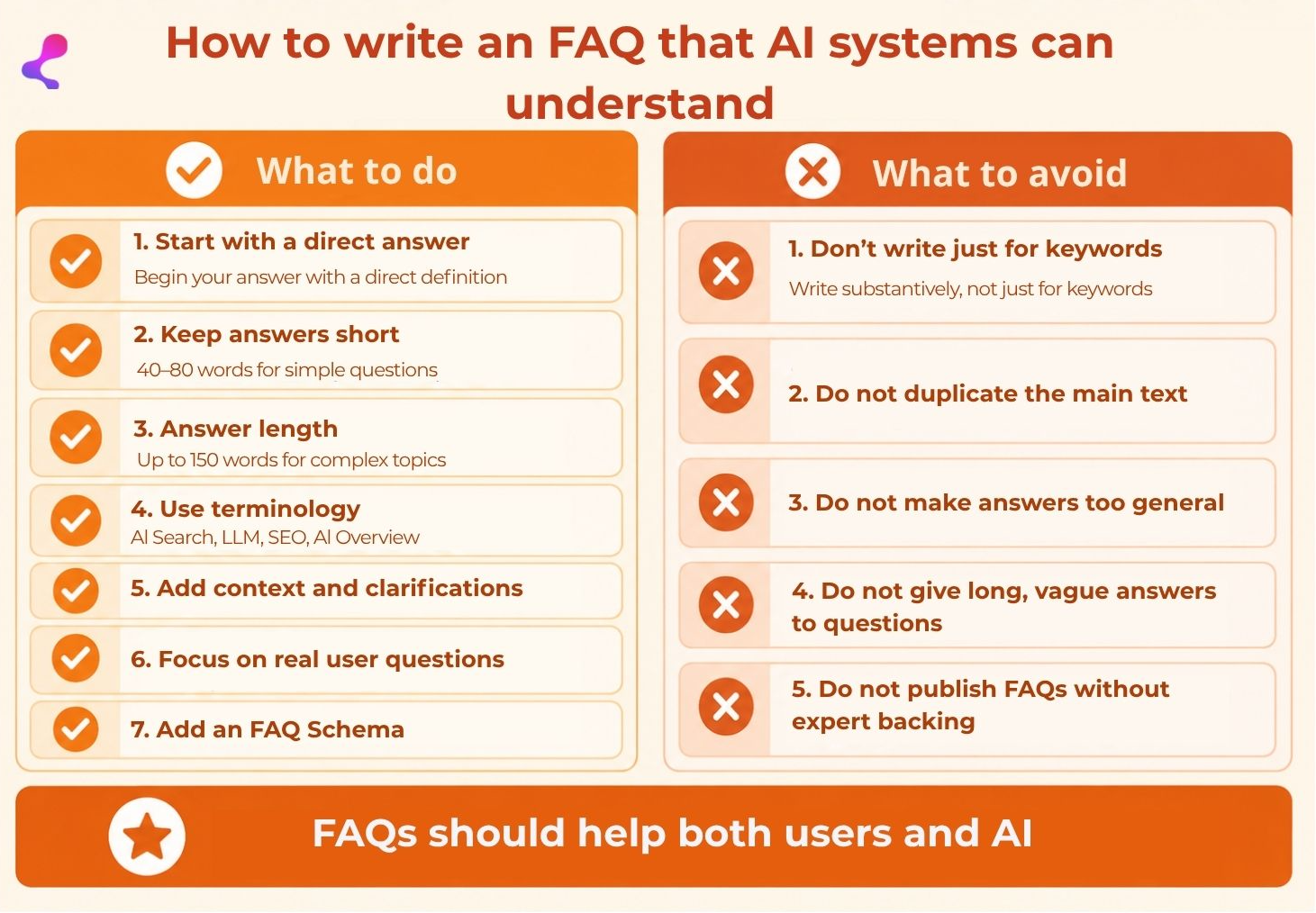
Start answers with a direct definition
The first sentence should clearly and unambiguously answer the question. Example:
«FAQ content is a structured block of questions and answers that helps both users and AI systems quickly find needed information».
Keep answers short but meaningful
Ideal length is 40-80 words for simple questions, up to 150 words for complex topics. Lengthy texts annoy both users and AI.
Incorporate entities and context
Naturally mention relevant terms like AI Search, LLM (large language models), SEO, generative search, AI Overview, FAQ structured data. This strengthens context and topical relevance.
Avoid keyword stuffing
Don’t unnaturally repeat phrases like «FAQ for AI search», «SEO for AI Search», or «FAQ content». Such answers look artificial, reduce readability, and AI systems may deem them less useful. Write concisely, clearly, and to the point: direct answer first, then add context or examples.
How to format FAQ blocks on a page
FAQ effectiveness depends not only on question and answer quality but also on how the block is integrated into the page structure. Place FAQs to complement main content, expand the topic, and answer additional user questions. Common FAQ block formats and their best-use cases:
FAQ within an article
Ideal for expert content, helping clarify extra questions without distracting users. Enhances the main article’s quality and thematic perception.
Separate FAQ page
Suitable for products, services, SaaS, and e-commerce with a large question set. Easier to organize and update regularly.
FAQ block on product or service pages
Useful for commercial pages with recurring pre-purchase questions. These can address payment, delivery, warranty, returns, and timelines, easing objections, boosting trust, and simplifying decision-making.
FAQ Schema and structured data: are they still needed in the AI Search era?
Despite advances in AI search, structured data still helps search engines better understand page content and identify page elements quickly. However, markup itself doesn’t guarantee inclusion in search or AI answers — content quality and usefulness matter most.
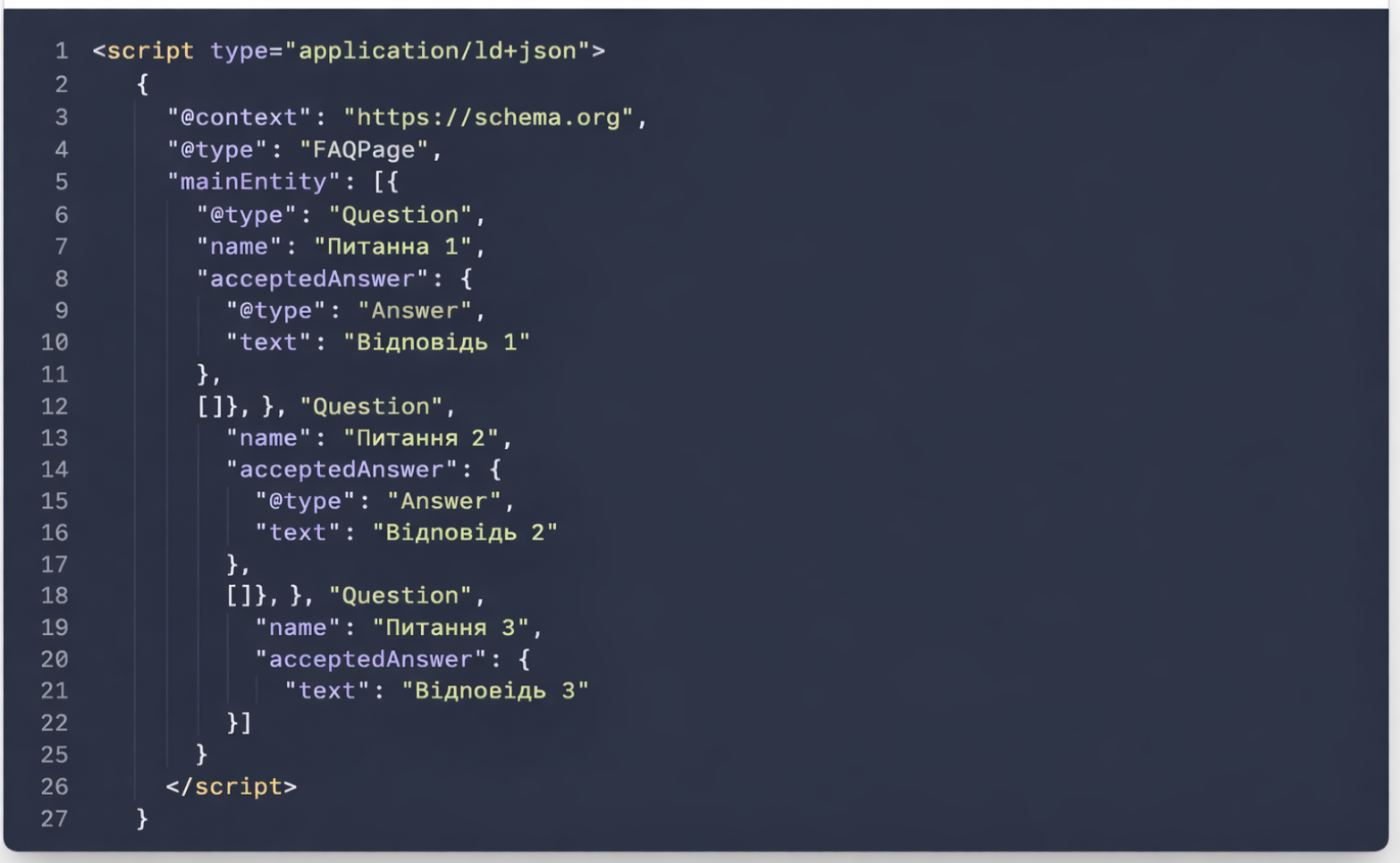
FAQ Schema is a type of structured data that helps search engines identify which parts of a page are questions and which are answers. It doesn’t directly improve content quality but makes the structure clearer for algorithms.
What FAQ Schema provides
Markup explicitly denotes structure and aids search engines in recognizing page content, improving chances to appear in rich snippets, voice search, and generative results.
Example of FAQ Schema:
Why markup alone is not enough
Markup is only a technical baseline. The key is quality, expertise, completeness of answers, and intent relevance. Without this, even perfect FAQ Schema won’t be effective.
Common mistakes in creating FAQs for AI Search
- Overly general questions. Broad questions like «What is SEO?» don’t provide AI with specific signals. Better: «How does FAQ help SEO in AI search?».
- Long, unfocused answers. Lengthy responses lose focus and clarity, frustrating users and AI alike.
- Duplicating main content. FAQ content should complement, not copy, the main article.
- Lack of expertise. Answers must be accurate, verifiable, and trustworthy. Poor quality lowers ranking and chances for AI citations.
Sample FAQ structure for an AI Search article
The FAQ block should respond to real user questions arising after reading the main content. This format unveils additional topic aspects, improves navigation, and enhances perception by users and AI systems. Example FAQ questions for an AI search article:
- What is FAQ content?
- Why is FAQ important for AI search?
- How does FAQ help get featured in AI answers?
- Is FAQ Schema necessary?
- How to write FAQs for LLMs?
- How many questions should an FAQ block have?
- Where is the best place to put FAQs on a page?
When preparing your own FAQ, don’t rely solely on template questions. Base it on audience search queries, Search Console data, search suggestions, and client questions. The better your FAQ meets actual user needs, the more valuable it is for SEO and AI search.
Conclusion
FAQ content in the AI search era is an indispensable strategy element to boost visibility and trust. To advance effectively, create structured, expert, concise, and topically relevant answers to real user questions. FAQ markup and structured data help search engines and AI better understand your content, but the key to success is quality and completeness of information.
Only this way can you improve your site’s rankings and become a source of the first and most accurate answers that AI Search and generative systems actively cite. The Idea Digital Agency team is ready to help you take this step into the future of SEO today.


