Key Takeaways
- An author page on the website is a full-fledged profile that reveals the identity, experience, and expertise of the content creator — not just a signature under an article.
- Having an author page increases trust in the site and its content from both users and search engines.
- An author profile helps form important quality signals for Google within the E-E-A-T framework (Experience, Expertise, Authoritativeness, Trustworthiness).
- Using structured data (Schema.org) on the author page simplifies the recognition of information about the content creator and boosts SEO effectiveness.
- Mistakes like missing biography or photo negatively affect site perception and reduce the SEO potential of the author page.
- If you regularly publish articles on your site, it makes sense to create and maintain up-to-date author pages — a profitable long-term investment in trust and site rankings.
Search engines increasingly scrutinize website content and its source: who prepared the material — for example, an article — the author’s experience, and whether their expertise can be verified. Therefore, an author page on the website has ceased to be a mere formality and has become a crucial part of building trust in publications, especially in niches where users need to understand whose opinion they rely on.
A verified author profile, biography, professional experience, and list of publications help Google better interpret the content and strengthen quality signals. Within the framework of comprehensive SEO website promotion, the author page functions as a strategic element: it increases the site’s transparency, strengthens user trust, and supports the brand’s expert positioning.
What is an Author Page and why does your website need it?
Have you ever wondered why some websites have a dedicated author page, while others limit themselves to a signature like «Author: Ivan Ivanov» at the end of an article? The difference is that an author page is a complete profile revealing the story, professional journey, and unique competencies of the content creator.
Unlike a simple signature under an article, which usually contains minimal information (name and perhaps position), an author profile is a separate page that gathers all key information:
- Full name linked easily to publications;
- Photograph, creating a sense of trust and humanity;
- Position or role within the company;
- Work experience and specialization;
- Links to author’s publications within the site;
- Contact details or links to social media.
Why is this important? Firstly, your visitors want to know who is behind the content. This is especially critical in fields like finance, medicine, law, or IT — where trust in the source is vital. Secondly, search engines like Google also take into account who creates the material. An author profile increases transparency and raises the overall trust level towards the website.
Why an Author Page matters for SEO
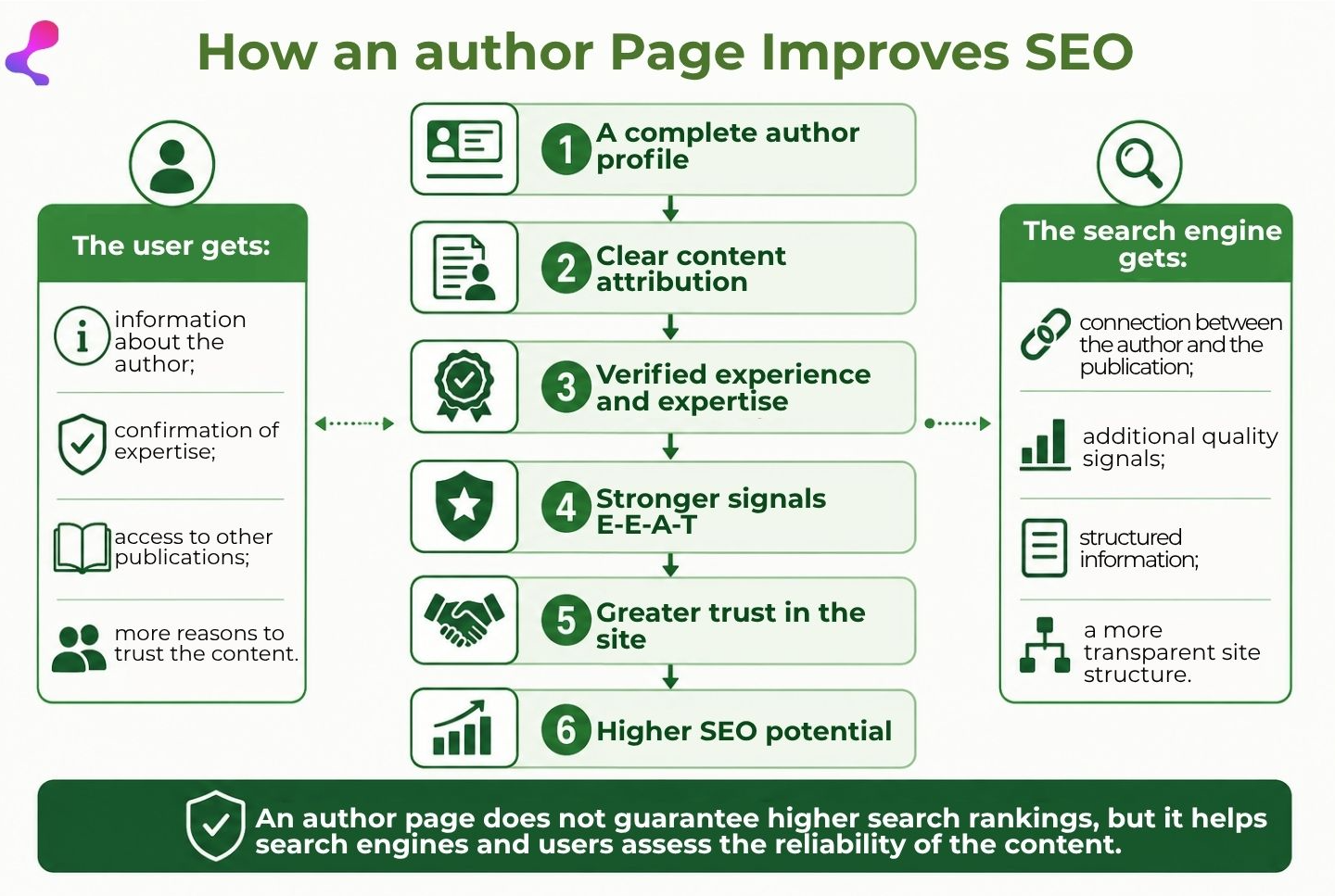
Can we say that an author page directly affects SEO ranking? No, Google does not officially state that the page itself boosts rankings. However, it is a powerful tool for building quality and trust signals that search engines consider when evaluating a site.
Why does this matter? Google is increasingly attentive to content authorship: who writes the articles, what experience they have, and how expert they are on the topic. Thus, an author profile operates on multiple levels — it helps confirm expertise, increase trust in the material, and make the site more transparent for the search engine.
- Trust in the author. A publication with a verified author profile shows both search engines and users a real expert, which reduces doubts about the reliability of information. The author page should be viewed as part of overall optimization rather than a standalone ranking booster. Tools such as a comprehensive SEO site audit help assess technical conditions, structure, and other ranking factors.
- Transparency and proof of expertise. A profile with a detailed biography, certificates, and work examples demonstrates the author’s competence.
- Improved site quality in the eyes of search engines. If several articles have equal usefulness, Google will prioritize the one with trustworthy author information, reducing the risk of misinformation.
How the Author Page connects to the E-E-A-T concept
What E-E-A-T means
E-E-A-T is a concept Google uses to evaluate content quality and source reliability. It stands for Experience, Expertise, Authoritativeness, and Trustworthiness. Simply put, Google wants to know whether the author has practical experience, sufficient knowledge, recognized expertise, and whether the published information is generally trustworthy.
- Experience — whether the author has hands-on experience with the topic. For instance, SEO content is more trusted if created by a specialist who actually does website promotion, performs audits, and works with search analytics.
- Expertise — the author’s professional knowledge and competencies, supported by education, certifications, work history, completed projects, publications, and specialization within a niche.
- Authoritativeness — reflects the author or brand’s reputation in the field. Authority may be indicated by mentions on related resources (link building), participation in industry events, backlinks, interviews, and expert commentary.
- Trustworthiness — a key aspect of E-E-A-T. Both users and search engines need to know who is responsible for the content, how transparent the author’s information is, and whether it can be verified. That’s why a detailed author profile, real contacts, and an up-to-date biography strengthen trust in both the material and the site overall.
How an author profile helps confirm expertise
A well-developed author profile on the website allows all E-E-A-T elements to be demonstrated visually:
- Education and qualifications confirming knowledge level;
- Professional experience and a list of completed projects;
- Certificates and awards reinforcing authority;
- Publications not only on your site but also external platforms;
- Achievements and client testimonials.
Expertise validation is supported not only by the biography but also by content planning. To ensure your articles correspond to real search demand and cover key topics, it’s important to work on semantic core collection and carefully cluster keywords — this will ultimately increase site authority.
What makes a good Author Page
Essential Page elements
When creating or auditing an SEO author page, ensure it includes the following components:
- Full name — for accurate identification;
- Photograph — helps establish a personal connection with visitors;
- Brief biography — key facts and achievements;
- Experience and specialization — the profile should explain what the author does professionally;
- List of articles and publications — useful for navigation and internal linking, improving indexing;
- Links to social networks or professional platforms — demonstrate that the author participates in the professional community;
- Contact details, if company policy allows.
These elements create a complete author portrait and make the page useful for both users and search crawlers.
Additional data to build trustworthiness
To make the profile look as authoritative as possible, it’s good to add:
- Scans or mentions of certificates and diplomas;
- Links to interviews and guest publications on external portals;
- Information on participation in niche conferences and webinars;
- Awards and recognitions;
- Current links to LinkedIn and other resources.
It’s important to keep information updated — adding new projects or certificates signals to search engines that the profile is active and maintained.
Structured data: rofilePage and Author Schema
Why Schema.org is needed
Using Schema.org markup shows Google that the page contains an author profile with specific fields: name, position, links to publications, and more. This improves information recognition and enhances the page’s display in search results, e.g., with rich snippets.
Commonly used schemas
For author pages, the following schema types are typically applied:
- ProfilePage — indicates the page is dedicated to a personal profile;
- Person — describes a physical person with various characteristics;
- author — links a publication with a specific author;
- Article — applies to individual articles, specifying the author.
Site owners and SEO specialists don’t need to dive deep into code but should understand that implementing these schemas improves communication with search engines.
Common mistakes when creating an Author Page
An author page won’t build trust or improve SEO if it’s unclear who created the material, how their competence is verified, or where to find their other publications. The following mistakes most often reduce profile effectiveness:
- No dedicated author page — if the information is only in a small block under the article, that’s not a profile but just a signature.
- Missing photo — people trust faces, not anonymous names.
- Too brief biography — lack of details weakens authority.
- No expertise information — e.g., certificates or experience are not listed.
- No list of publications — users find it hard to locate other works by the author, and the site loses internal structure.
- No links to social media or profiles — reduces transparency and the ability to verify details.
- Page not updated — loses current experience and achievements.
- No structured data (Schema.org) — search engines less likely to recognize the page as an author profile and to show rich snippets.
All these errors can lead to reduced trust from Google and faster user bounce.
Conclusion
An author page is a vital tool to increase trust and improve content perception, positively influencing SEO. By creating a high-quality and detailed author profile on your website, you strengthen E-E-A-T signals, confirm expertise, and enhance transparency for search engines, helping improve ranking positions.
If you regularly publish articles or plan to grow a blog, creating and maintaining author pages is a smart strategic decision. It’s an investment in long-term trust in your brand and increased organic visibility.
For comprehensive analysis and implementation of such solutions, we recommend starting with a consultation and SEO site audit at Idea Digital Agency — our experts will help identify and execute the best optimization path.