
Key Takeaways
- First place on Google isn’t always a classic organic result anymore. SERPs now often include featured snippets, maps, videos, and AI-powered blocks.
- CTR (click-through rate) is a key metric influenced by search ranking position, but a well-crafted snippet can significantly boost CTR even if the position is lower.
- Google ranks sites not by absolute quality but by maximum relevance to the query, taking into account search intent and user signals.
- Вeing number one in the top results doesn’t always guarantee the most customers or sales; comprehensive site visibility across a cluster of keywords matters more.
- SEO is about more than just rankings — it requires quality content, technical optimization, strong UX, and brand signals. Focus on the bigger picture, not just the №1 spot.
Many companies and website owners assume that ranking first on Google automatically guarantees high traffic, a steady flow of customers, and increased sales. However, first place on Google has long ceased to be an unambiguous indicator of website success.
Today, users often see ads, maps, videos, AI blocks, or featured snippets even before organic results appear. Therefore, even a page holding the highest SEO position may not get the most clicks. Moreover, a high ranking alone does not always ensure the maximum CTR, since click volume depends heavily on search intent, snippet attractiveness, and query type.
As a result, «first place» on Google can mean very different things — from a traditional organic listing to an extended featured snippet block. In this article, we’ll explore how Google’s search results actually work, what factors influence site ranking, and why competing only for the TOP-1 spot has long ceased to be the sole goal of effective SEO website promotion.
What counts as First Place on Google today?
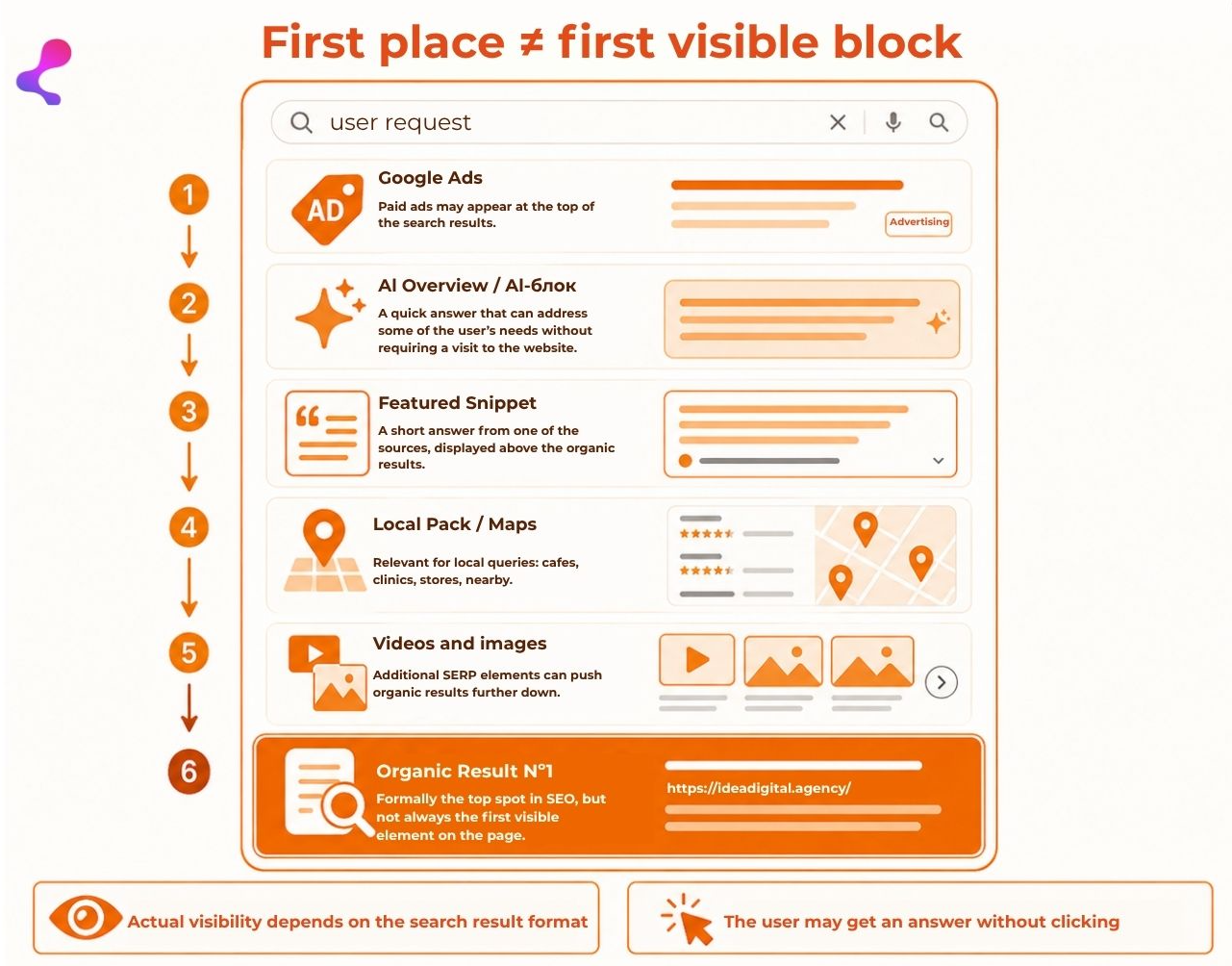
Just a few years ago, first place on Google was clear-cut — the top organic result appearing beneath ads and carousels. Today, the picture is far more complex. Google actively incorporates various content formats and interfaces: Google Ads, featured snippets (highlighted answers), local map packs, YouTube videos, as well as AI-generated answers and interactive dialog boxes.
This means when we talk about first position on Google, we need to clarify exactly what we mean. For users, first place might not be a traditional website in organic results at all, but rather an info card with a quick answer (featured snippet). Or the top visible spot could be an ad block that visually appears as number one but isn’t related to SEO. Understanding what it means to be «top» on Google today helps businesses evaluate not just rankings but actual visibility and clickability.
Organic results vs Paid Ads
Paid blocks in search (Google Ads) are a paid tool that works well in the short term, especially for promoting campaigns and new product launches. SEO is a long-term investment in organic traffic that grows more valuable over time.
Users tend to trust organic results more, especially for informational and commercial queries — a fact supported by numerous search behavior studies. Skillfully optimizing snippets and titles can help SEO results perform well despite competition from ads.
Why the №1 spot isn’t always «On Top»
Instead of seeing the website holding the first organic position below ads, a user might first encounter a featured snippet — a concise answer extracted from a top trusted source. These blocks often take prominent positions above results and sometimes create a zero-click search, where the user gets the information they need without clicking further.
Also, AI panels appearing in search may provide direct answers, reducing clicks to traditional links. Under these circumstances, a №3 or lower organic position with a well-crafted snippet can attract more traffic thanks to better visibility and appeal.
How Google determines First Place
Google evaluates pages based on hundreds of factors to identify which result best answers the user’s query. The search engine analyzes not only the presence of keywords but also how well the page matches the search intent, content usefulness, and the degree of trust other resources place in the site. Ranking algorithms are constantly updated, so mechanically stuffing keywords is long ineffective.
A fundamental factor is relevance. Google strives to understand how closely the page content matches the query’s meaning. For example, if a user seeks instructions, detailed guides and articles dominate rather than commercial service pages. For commercial queries, Google prioritizes online stores, product categories, and landing pages.
The next level is site authority. Google assesses domain reputation, quality of backlinks, brand mentions, and content expertise. The more authoritative sites reference a page, the higher the likelihood of good SEO positions. Here, the quality and topical relevance of links far outweigh quantity.
Content usefulness is another key role. Algorithms analyze topic depth, material structure, originality, and a page’s ability to quickly fulfill the user’s query. Thin content overloaded with keywords loses out to pages offering clear, comprehensive answers.
Google also considers behavioral signals: CTR in search results, time on page, search refinements, and user interactions. If visitors quickly leave a page or return to search, the algorithm receives low relevance signals.
Together, these factors are embodied in the E-E-A-T concept — Experience, Expertise, Authoritativeness, Trustworthiness. Google seeks to promote pages crafted by experts, based on real experience, and trusted by users.
Main Google ranking factors
- Content quality. Text should be unique, thoroughly cover the topic, include LSI vocabulary, and provide useful information for users.
- Link profile. Internal and external links build trust and demonstrate page importance.
- Site speed. Fast loading positively impacts ranking by improving user experience.
- Mobile-friendliness. Sites without adaptive versions lose positions since most visitors are mobile users.
- Usability (UX). Easy navigation, clear interface, and minimizing distractions improve behavioral metrics.
- Behavioral signals. Bounce rate, average time on page, and depth of interaction influence resource usefulness assessment.
- Technical SEO. Proper site structure, schema markup, and correct keyword usage help Google better understand content.
Why Google might not show the «Best» site first
Google doesn’t aim to show simply the «best» site; it ranks results primarily on relevance to the specific query and user intent:
- Informational queries. When the user wants to learn something, Google may favor detailed articles or featured snippets.
- Commercial queries. For example, «buy a laptop in Kyiv» — Google shows local sellers with the best offers, discounts, and ratings. Here, the top result is not necessarily the most authoritative but the most relevant and purchase-ready.
- Local queries. For example, «cafes near me» — Google prioritizes maps, reviews, and geolocation over general site ranking.
Thus, what we call «number one on Google» often depends on search intent, which must be considered in any SEO strategy.
The real value of First Place in Search
The idea that first place guarantees maximum sales and clients is a myth. Position value often depends on niche, query nature, and the ability to convert views into conversions.
For some businesses, ranking in the TOP-3 across a broad keyword cluster is more valuable than narrowly winning with a non-relevant search term. Our experience shows that a steady traffic flow from multiple queries beats short-lived spikes for a single top keyword.
CTR and click distribution in Search Results
CTR (Click-Through Rate) is the percentage of users who click a link out of those who saw it. Studies show that the first organic result typically receives about 28-35% of clicks, depending on industry, but a poorly crafted snippet can reduce this figure to 10% or less.
Titles and descriptions significantly influence CTR. A well-written title with key phrases and a clear value proposition increases user interest.
When First Place doesn’t bring traffic
Despite holding position №1, sometimes traffic is low or nonexistent:
- Zero-click queries. Users get their answer directly from SERP (featured snippet, Knowledge Graph) without visiting the site.
- Narrow low-frequency queries. The audience is too small to bring significant traffic.
- Poor title and meta description. Unclear or irrelevant snippets repel users.
- High ad competition. Users first click ads, lowering organic CTR.
How to get to First Place on Google
True SEO is systematic work aimed at achieving sustainable, quality website visibility. Here are the main steps we apply at Idea Digital Agency for clients of all sizes.
Semantic core and Search intent analysis
The semantic core is a set of keywords and phrases you want to rank for. It’s important not just to collect a large keyword list but to group them by meaning and cluster according to user intent. This shapes site structure and content planning.
For example, keywords indicating commercial intent like «buy», «price», «order» form one group, while informational queries like «how to», «what is» go into another. This allows you to create more relevant and targeted content, improving rankings.
Creating content that Google loves
Quality content remains a key ranking factor. Algorithms evaluate not only keywords but also how useful, topical, and intent-aligned the page is. SEO content written solely «for rankings» without real user value gradually loses ground. When creating SEO content, Google pays attention to:
- Structured text — divided into paragraphs with headings, lists, tables, images.
- Demonstrated expertise — ideally written by authors with experience, citing authoritative sources.
- Uniqueness — copying content risks penalties.
- Thorough topic coverage — answering all user questions, including LSI terms.
- Regular updates — Google values fresh and relevant content.
Following E-E-A-T, Idea Digital Agency experts recommend adding expert opinions and real experience to boost trust. Internal linking helps keep users engaged longer and distributes page authority.
Technical SEO and UX
Technical SEO determines how quickly Google can crawl, index, and properly display site pages. Technical errors hurt indexing, slow loading, and degrade user experience — all directly impacting rankings. Key parameters include:
- Site speed — image optimization, caching, code minimization
- Core Web Vitals — Google’s UX assessment metrics
- Mobile version — responsive design is a must
- HTTPS — site security positively influences ranking
- Clean URL structure — short, readable page addresses
- Schema markup — structured data helps Google understand content better
These factors influence site health and user interaction. Slow loading, poor mobile design, or complex navigation worsen behavioral factors and reduce SEO effectiveness.
Why focusing only on №1 is a mistake
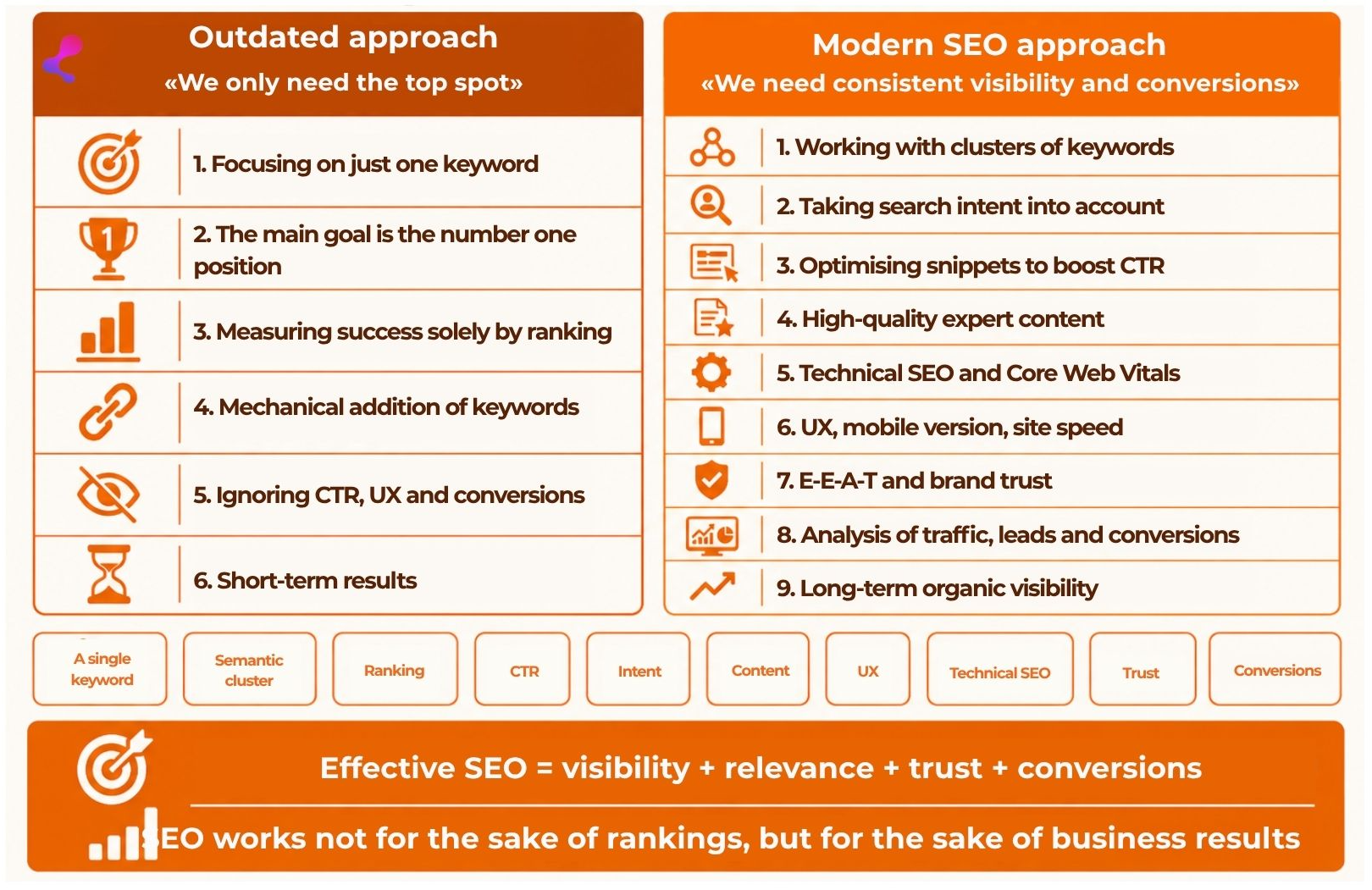
Fixating on the single top position is an outdated approach. SEO today is a complex blend of content quality, semantic coverage, user and search engine trust, branding, and conversions — not just rankings.
Many of our clients report that steady traffic from a broad array of smaller queries brings more value than fleeting first place on a single keyword. Working on overall site visibility and usefulness creates long-term competitive advantages and resilience to algorithm changes.
Conclusions
First place on Google can no longer be seen as the sole criterion of SEO success. SERPs have become far more complex — users interact with featured snippets, AI blocks, maps, videos, and other elements before organic results. Thus, a high ranking alone does not guarantee maximum traffic or conversion growth.
Promotion effectiveness today depends on how well the page meets search intent, attracts attention on SERP, and fulfills user needs after clickthrough. Google assesses overall resource quality: content, UX, technical SEO, behavioral signals, and site trust.
Modern SEO is systematic work on site visibility and user experience, not just a race for the №1 spot. Companies adapting to algorithm changes and prioritizing real audience value secure more stable organic traffic and long-term success.
FAQ
1. How long does it take to reach the TOP of Google?
It depends on niche competition, site condition, and work done. Typically, stable results can be seen in 3–6 months, but some cases may take up to a year.
2. Can you rank first without backlinks?
Links remain an important ranking factor, especially in competitive niches. However, in low-competition or local niches, it’s possible to reach the top without aggressive link building.
3. What’s more important: SEO or Google Ads?
SEO delivers long-term organic traffic and trust but takes time. Google Ads yield immediate results but require ongoing investment. An optimal strategy combines both.
4. Why did my site drop sharply in rankings?
Reasons vary: algorithm updates, UX deterioration, technical errors, content quality decline, or lost links. A full SEO audit is recommended.
5. How do I check my site’s rankings?
Use specialized tools (Serpstat, SEMrush, Ahrefs) and our internal agency tools. It’s important to monitor ranking trends, not just current positions.


