
Key Takeaways
- Query Fan-Out is the process of breaking a single search query into numerous additional sub-queries for deeper analysis.
- Traditional search was based on a «one query — one result» principle, while AI Search operates more complexly by generating dozens of clarifications.
- This approach enables AI to better understand user intent and produce comprehensive answers.
- For SEO, it’s crucial to create broadly topical content integrated with related questions and entities (topical authority).
- Without adapting to Query Fan-Out, brands risk becoming invisible in new AI-powered search models.
- Optimizing for Query Fan-Out requires adding FAQs, case studies, comparisons, and expert data.
- The future of search engines lies in technologies that consider query complexity and deliver maximally useful answers based on multiple data points.
Modern search is no longer what it used to be a few years ago. The emergence of AI Overviews, Google AI Mode, ChatGPT Search, and Perplexity has radically transformed the ways we search for and receive information online. Whereas search results were once built on direct matches to a single user query, today AI breaks that query into dozens of additional, refining, and related terms to provide more detailed and higher-quality answers.
This technology is called Query Fan-Out — the process where a single user query «fans out» into numerous subqueries that are explored simultaneously. For SEO website promotion and brand visibility online, this is a real breakthrough: now it is important not only to rank for a specific keyword but to cover the topic holistically.
What is Query Fan-Out?
Classic search is based on a simple model: a user enters a query, the search engine returns a relevant list of documents matching that query. This can be called «1 query = 1 result».
With the advent of AI technologies, there is a fundamental shift. Instead of a single result, AI Search operates on the principle of «1 query = many search queries». AI breaks down the original question into multiple parts to better understand the context and provide more precise recommendations. This process is often called query expansion or query decomposition, and collectively it is known as Query Fan-Out.
Simple definition of Query Fan-Out
Query Fan-Out means the AI system doesn’t stop at looking for an answer to one query but generates dozens of clarifying questions itself to gather complete and highly accurate information.
Imagine you ask: «Which CRM is best for an online store in Ukraine?» Classic search simply returns sites that answer this query.
AI, however, automatically generates additional clarifications such as:
- best CRMs for e-commerce;
- CRMs for small businesses;
- CRMs integrated with Nova Poshta;
- comparison between HubSpot and Pipedrive;
- CRM system pricing.
Each of these subqueries helps collect well-rounded information necessary to create a detailed, relevant, and helpful response.
Why AI does not limit itself to one query
The main reason is that AI aims not only to answer but to understand the user’s intent (search intent). Most queries are complex and contain hidden nuances that a single direct query cannot fully capture.
To formulate an extensive and useful answer, AI triggers a series of additional searches — clarifying and complementary.
This allows AI to:
- obtain a fuller context of the query;
- cross-check information across multiple sources;
- eliminate ambiguities and inconsistencies.
How Query Fan-Out technology works
Query Fan-Out changes the very approach to search optimization. Whereas a page used to earn traffic by exactly matching a specific query, AI search now evaluates how comprehensively content covers a topic and its related subtopics. During query processing, the system may trigger dozens of additional searches, so answers increasingly include materials covering not just the main question but also related aspects, comparisons, examples, and connected entities.
For SEO, this means growing importance of topical coverage and content expertise. If a site appears only for the main query but lacks information on related subtopics, it risks being overlooked by AI search. Conversely, resources with deep topic coverage stand a better chance to be featured in AI answers, as they satisfy multiple subqueries generated by Query Fan-Out. This influences keyword selection, content structure, approach to expertise, and even which sources AI systems use when generating answers.
Step 1. User Query analysis
First, AI interprets the intent behind the query, highlights key entities and hidden questions that may underlie the initial wording. For example, if a user types «What is GEO-optimization?» AI breaks down the query into:
- what is GEO;
- how GEO differs from SEO;
- what results GEO implementation brings;
- what risks are involved in switching.
This decomposition helps AI build a more holistic and informative answer.
Step 2. Query decomposition
Next, the single query fans out into dozens of subqueries processed simultaneously — this is the core of Query Fan-Out technology (Query Decomposition).
AI analyzes every aspect of the task to avoid missing technical, commercial, or user details.
Step 3. Searching information across multiple queries
Now the system simultaneously searches data from many sources: web pages, knowledge bases, forums, analytics, and proprietary models. This broadens the data pool and ensures reliability of conclusions.
AI cross-references data, finds confirmations of different viewpoints, which enhances answer quality.
Step 4. Answer synthesis
After gathering information, the LLM (Large Language Model) merges all data and forms a single, coherent, user-friendly response.
Thus, instead of a simple list of links, you get comprehensive recommendations accounting for all nuances. This creates the feeling of an «intelligent», personalized search.
How Query Fan-Out differs from classic Google Search
The main difference lies in query processing logic. Classic search picks pages that best match the entered phrase. AI search first expands the query, breaks it into related sub-tasks, gathers data from various sources, then generates a complete answer.
Classic Search
In classic search, a user inputs one query, for example «best CRM for small business», and the system selects a set of documents it considers most relevant. Google analyzes pages, assessing content, authority, technical quality, behavior signals, and ranks results.
Users themselves open multiple sites, compare offers, check prices, review features, and make decisions. The search engine mainly functions as a navigator: showing where the answer might be but not assembling it fully.
AI Search
AI search works differently. It does not stop at the original phrasing but creates numerous hidden subqueries to understand the task more broadly. Instead of just one set of documents, it may consult various source types: overviews, comparisons, ratings, documentation, reviews, product pages, and expert materials.
Then AI consolidates the collected data and generates a final answer. The user receives not just a list of links but a distilled summary: which options fit, criteria for comparison, constraints, and why one is better than another.
Comparison Using One Query
Query: «Which CRM to choose for small business?»
Classic Google search returns a list of sites: CRM ratings, ads for services, curated articles, reviews, and aggregators. The user must open several results, compare functionality, prices, integrations, and figure out the best fit for their needs.
AI Search transforms the same query into a series of internal clarifications: best CRMs for small businesses, necessary sales features, pricing of popular CRMs, easiest to implement services, available integrations, differences between HubSpot and Pipedrive. Then it gathers data from multiple sources and generates a ready-made recommendation explaining which option suits what scenarios.
Why Query Fan-Out is changing AI Search
The main goal of Query Fan-Out is to turn one user query into a set of related searches that help the system gather more context and find information from different angles. Instead of searching for an answer to a single phrase, AI analyzes the entire topic, checks connected aspects, refines details, and cross-references data across sources.
Answer quality in AI search has improved dramatically. The system no longer relies only on exact keyword matches and can factor in additional criteria influencing user decisions. As a result, answers become more complete, accurate, and useful — even for complex queries requiring analysis of several parameters simultaneously.
Deeper understanding of user intent
Query Fan-Out allows AI to analyze not just query wording but its sense. Instead of searching pages by isolated words, the system tries to determine what task the user wants to solve and what information they expect.
For example, «best CRM for small business» may mean a desire to compare options by price, features, ease of implementation, or integrations. To pinpoint genuine search intent, AI triggers additional subqueries and examines related topics. This enables it to craft answers matching the user’s needs, not just the query text.
More accurate answers to complex questions
Query Fan-Out is especially effective for complex queries where decision-making depends on many factors simultaneously. Instead of searching for one document, AI collects data along multiple lines and unifies it in a single answer.
For instance, when choosing CRM, the system may analyze license costs, automation capabilities, integrations, and platform scalability. Similar logic applies to queries about hosting, ERP systems, or marketing tools comparisons. Each such query is automatically broken down into dozens of related themes, letting AI consider more criteria and provide well-founded recommendations.
How Query Fan-Out affects SEO
Query Fan-Out changes the criteria for a site’s visibility in search. Now it’s not enough to rank for the main query; your presence in related subtopics that AI uses to build answers is crucial. If a page only superficially covers the topic, it may be excluded from AI answers even if it contains the right keyword.
Why a single keyword is no longer enough
Classic «keyword-based» search loses effectiveness because AI search works with a set of related queries, not just one phrase. A page optimized only for «query distribution» could lose to material that also explains Query Decomposition, AI Search, Google AI Mode, Search Intent, and the technology’s SEO impact.
Hence, topical coverage becomes increasingly important in SEO. Content must address not just a single keyword but the entire semantic cluster: definitions, working principles, examples, differences from classic search, ranking influence, and practical business insights.
Why sites with deep expertise win
AI search often prefers sources demonstrating deep topic understanding. This is linked to Topical Authority — a site’s authority in a specific subject. A resource that regularly publishes materials on SEO, AI search, Search Intent, Entity SEO, and generative systems has greater chances to be recognized as a reliable source.
Connections between concepts are especially important. AI evaluates not only keyword presence but how entities relate within content: Query Fan-Out, LLM, Google AI Mode, AI Overviews, intent, sources, brands, technologies, and search scenarios. Therefore, AI-driven entity relationships matter more than simply adding similar phrases.
Why many brands fail to appear in AI answers
AI generates answers based on dozens of subqueries. For example, for »best CRM for small business», it may separately analyze prices, reviews, integrations, industry use cases, alternatives, and comparisons. If a brand only appears for the main commercial query but is absent in these supporting clusters, AI may not include it.
This renders the brand invisible in generative search. It might have a website, landing pages, and rankings in classic search, but not appear in AI answers due to lack of presence in reviews, comparisons, expert content, FAQs, case studies, and related informational queries.
Changes in SEO and GEO Strategies
SEO remains important for classic search: technical optimization, site structure, indexing, content, and links still drive organic traffic. But this is no longer enough for AI search, since generative systems select sources by coverage completeness, clarity, expertise, and ability to address multiple related intents.
Thus, SEO is supplemented by GEO — Generative Engine Optimization. Its goal is to improve brand visibility in generative answers from ChatGPT Search, Perplexity, Google AI Mode, and other AI systems. This includes Answer Engine Optimization: creating content easily used as a direct user query answer. The strategy shifts from optimizing a single page for one keyword toward building a topical ecosystem where the brand appears in all significant subqueries generated by Query Fan-Out.
How to optimize content for Query Fan-Out
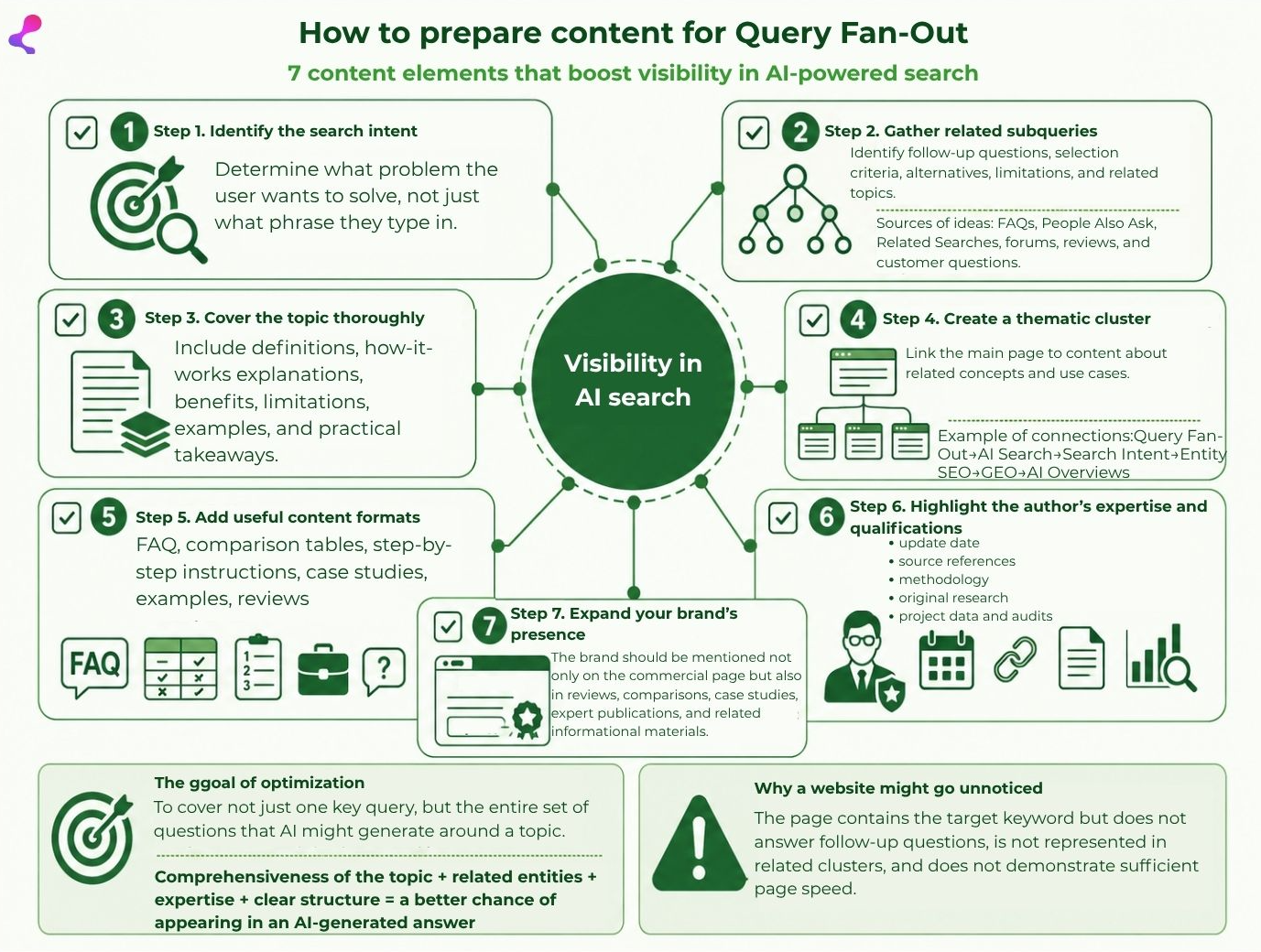
Optimizing for Query Fan-Out revolves around comprehensive topic coverage. Content should answer not only the main user query but also additional questions AI may generate while analyzing intent. Therefore, the work begins not with mechanical keyword stuffing but with restructuring content logic: the page must be useful not only for one query but for the entire chain of clarifications AI might create around the topic.
Cover the whole topic, not just a single query
The page should be part of a Topic Cluster — a group of materials exploring one subject from different angles. For example, an article about Query Fan-Out should link to content on AI Search, Search Intent, Entity SEO, Google AI Mode, AI Overviews, GEO, and Answer Engine Optimization.
Building semantic connections between concepts is vital. AI must understand how key entities relate: Query Fan-Out, query decomposition, LLM, generative search, data sources, search intent, and SEO. The clearer these connections, the higher the chance content will be used to form AI answers.
Answer related user questions
Since Query Fan-Out works via additional subqueries, content must address surrounding questions. It’s helpful to analyze FAQ blocks, People Also Ask, Related Searches, and real user formulations.
For example, an article about Query Fan-Out might incorporate queries like: what is Query Fan-Out, how does it work, how is it different from Query Decomposition, how is it used in Google AI Mode, why does it impact SEO, and how to adapt content for AI search. Blocks answering these increase chances AI will select the page as a source for precise answer snippets.
Add comparisons, examples, and case studies
AI search prefers content rich in context: comparisons, use cases, practical examples, and cause-effect explanations. These help the system do more than just find a definition — it understands how the technology works in real search situations.
For instance, comparing classic Google Search and AI Search illustrates why one query turns into dozens of internal subqueries. Case studies link theory with practice: how a brand may rank for a main query yet miss AI answers due to absence in related clusters.
Strengthen content expertise
Content must demonstrate why the source is trustworthy. This involves showing authorship, author expertise, update dates, data sources, analysis methodology, and the company’s practical SEO or AI search experience.
Added value comes from original research, audit data, project insights, ranking comparisons, and company case studies. Such content is harder to replace with generic summaries and better suits AI answers: the system gets not just a topic description but verified expert context.
Conclusions
Query Fan-Out has become a key mechanism in modern AI search. Instead of processing a single query, the system generates many additional searches, analyzes different topic facets, and only then constructs the final response. Query Fan-Out helps AI better understand user intent and deliver more accurate and useful results.
For SEO, this means shifting from optimizing for isolated keywords to working with entire topical clusters. Today, it is not enough to create a page for a specific query — it is vital to fully cover the topic, address related questions, entities, and usage scenarios. The more information helps close subqueries arising from Query Fan-Out, the better chance to be included in AI answers.
As Google AI Mode, ChatGPT Search, Perplexity, and other generative search engines evolve, brands will need to adapt content to this new search model. Winners will be sites that systematically develop expertise, build topical authority, and create materials capable of answering not just one user question but the whole complex of related needs.


