Key Takeaways
- AI search marks a new era of retrieval, where ready-made answers are generated based on the analysis of numerous sources, rather than just a list of links.
- AI-powered search engines select sources based on relevance, expertise, timeliness, and content structure.
- One of the main factors for inclusion in AI answers is creating citation-ready content: concise, clear facts, specific answers, and well-structured blocks.
- Technical accessibility, site authority, and transparent authorship significantly influence the chances of becoming a source for AI Search.
- Optimization for AI Search and GEO requires new approaches: questions in headings, clear answers, tables, FAQs, and regular updates.
- Avoid keyword stuffing, content duplication, and generic, unverified materials — AI values depth and unique expertise.
- Regular analysis, updating, and content expansion are key to maintaining a stable presence in AI search results.
Internet search is rapidly evolving. Whereas Google and other engines traditionally displayed a list of links, today AI tools such as Google AI Overviews, Bing Copilot and ChatGPT generate a ready answer to the user’s query. Instead of navigating multiple websites, users often receive a brief, structured explanation directly in the results.
This means the role of websites in search has changed. Even if a site is well-optimized for classic SEO and ranks highly in organic results, this is no longer sufficient to appear in AI-generated answers. AI algorithms select a limited number of sources deemed most relevant, authoritative, and convenient for information extraction.
As a result, an important issue arises for businesses and SEO specialists: a site may consistently receive search traffic but be completely absent from AI-generated answers. This directly affects brand visibility and the future share of organic traffic.
Therefore, the key question today is: how do AI-powered search engines select their sources and what must be done to make your site more often become such a source? The answer is closely tied to modern approaches and strategies, including SEO promotion, which already take into account the principles behind generative search and AI results.
What is AI Search and how it differs from classic search results
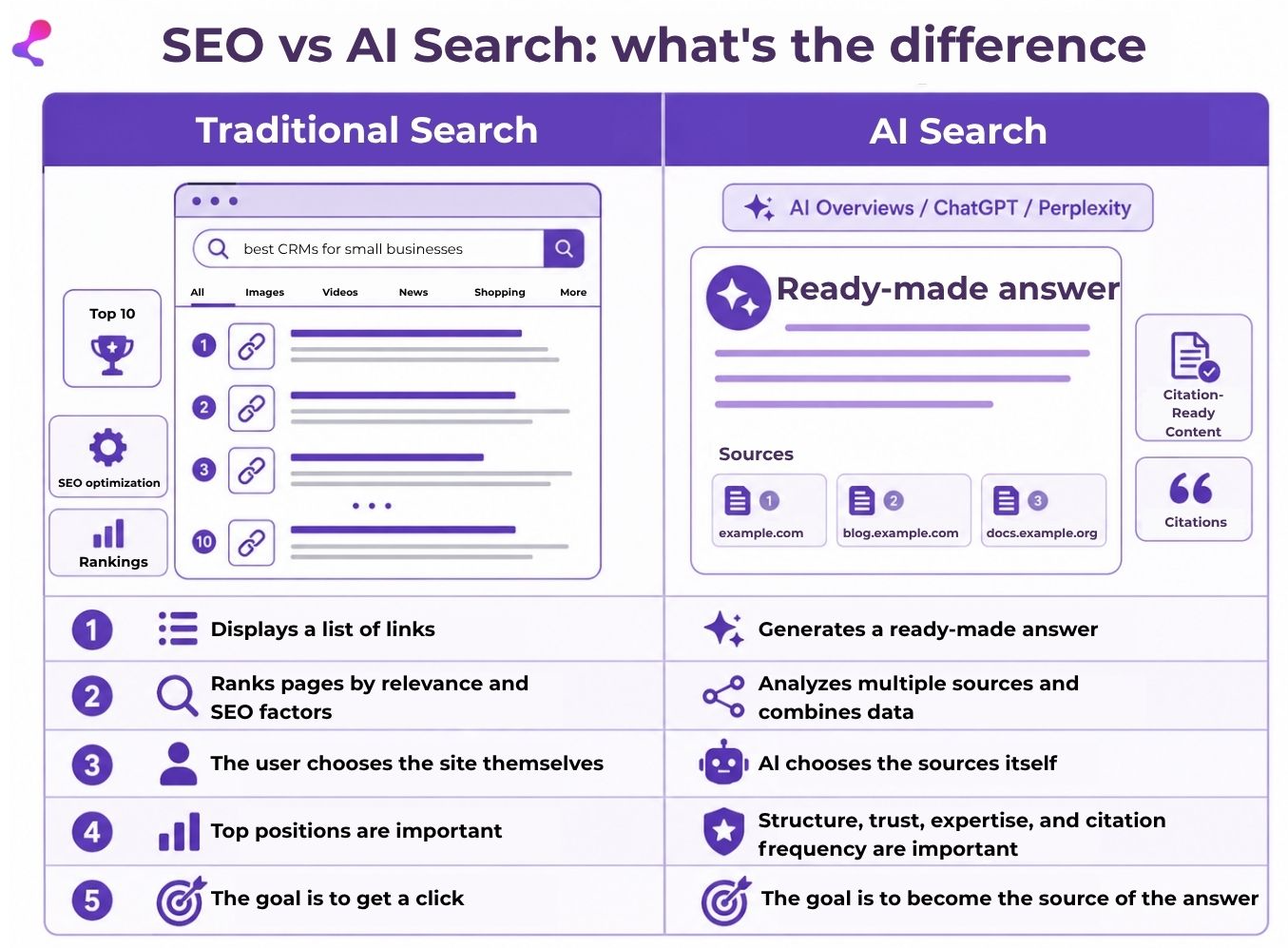
AI search is an information retrieval method based on artificial intelligence that does not just display a list of links but analyzes the query, cross-references data from various sources, and forms a ready-made answer.
Currently, AI search develops in two main directions. The first involves generative features embedded directly into search engines, such as Google AI Overviews and AI Mode, powered by Gemini models. The second includes AI assistants with internet search capabilities, such as ChatGPT Search, Gemini, and Claude, which also analyze web sources and compose answers based on gathered information. In all cases, users don’t need to browse dozens of pages; instead, they get a structured answer with key insights and source citations.
While classical search primarily ranks pages by how well they match the query, AI search takes a step further: it analyzes information from multiple sources, synthesizes it, and produces a single consolidated answer. Thus, not only a site’s search ranking but also content quality, accuracy, and structure matters.
This approach changes the rules of the game for SEO. Even a well-optimized site for traditional algorithms no longer guarantees inclusion in AI answers. To become a source for generative search, content must meet additional criteria: be expert-level, relevant, logically structured, and easy for AI models to extract information from.
How classical search works
In classical search, users enter a query like «SEO website promotion». The search engine analyzes pages for keyword relevance, ranks them by relevance and external factors (backlinks, user behavior, etc.), and creates a list—top 10 or more—of matching pages. The user chooses which link to click to find the required answer.
How AI Search works
AI search operates differently. It «reads» and processes texts from several sources simultaneously, selects the most useful information, and composes a summary response to the user’s query. Not only keyword relevance but also completeness, structure, expertise, and site trustworthiness play crucial roles. The answer is presented as a concise text, sometimes including quotes and links to sources.
Why it matters for SEO
Today, ranking in the top 10 is not enough. To gain extra traffic and attention, you need to become an information source for AI answers — those generated by Google AI Overviews and other generative search engines. These enhance trust in your company and increase visibility in new search result formats.
What sources do AI-Powered search engines use?
AI search engines don’t generate answers «from thin air» — they rely on pre-existing data available on the internet. Today, AI search can’t be limited to Google or Bing alone. It evolves in several formats.
The first format is AI features inside classic search engines: for example, Google AI Overviews and AI Mode based on Gemini, and Bing with Copilot integration. The second consists of standalone AI search engines and answer engines, like You.com, or Brave Search AI, which focus on ready answers with sources rather than just links. The third includes AI assistants with web search, such as ChatGPT, Gemini, and Claude, where users ask questions in a conversational interface and receive answers compiled and summarized from online data.
Across all these cases, AI systems use various source types: websites, knowledge bases (Knowledge Panel), news articles, expert publications, official docs, reviews, studies, and other authoritative materials. Key factors include not just the presence of information but its quality, structure, relevance, and trustworthiness.
Pages from organic search results
AI search often draws on pages already indexed and relevant to the user’s query. This doesn’t mean it only takes content from the top 3 or top 10; however, pages ranking well generally have a better chance.
The reason is that such content shows the search engine important quality signals: query relevance, user utility, clear structure, sufficient thematic depth, and site trust. If content answers a question well, is logically organized, and matches search intent, AI is more likely to use it as a source for answer generation.
In other words, classical SEO remains a crucial base for appearing in AI results. But high ranking alone doesn’t guarantee citation — it’s equally essential that phrasing is precise, content expert, current, and easy for AI to extract.
Authoritative sites and expert publications
AI systems aim to minimize errors and thus favor highly credible sources. Priority goes to sites with solid reputations, expert content, and clear authorship transparency.
Especially valued are materials where:
- The author and their qualifications are specified;
- There are references to studies, statistics, and primary sources;
- The content is an expert analysis, not a superficial overview.
Such pages are seen as more reliable and are more likely to be used in AI-generated answers. This is closely linked to the E-E-A-T principles (Experience, Expertise, Authoritativeness, Trustworthiness), which are critical in the AI search era.
Fresh and relevant content
For rapidly evolving topics such as SEO, artificial intelligence, marketing, or technology, content freshness gains substantial importance. AI search strives to provide users with the most current and relevant information.
Thus, priority is given to materials that:
- Have recent publication or update dates;
- Contain up-to-date figures, tools, and examples;
- Are regularly supplemented and expanded.
Articles that are not frequently updated gradually lose chances to appear in AI answers, even if they previously ranked well. In generative search, freshness is one of the key visibility factors.
Knowledge Base (Knowledge Panel)
Another important source for AI search is knowledge bases (Knowledge Graph and Knowledge Panel), used by search engines to generate verified reference information. These are structured data about entities — companies, people, brands, places, events, and concepts.
AI systems rely on such data because it is considered the most «clean» and verified: information is aggregated, normalized, and partially validated by algorithms and editorial sources. Consequently, facts from knowledge bases are often utilized as a foundation for concise answers, definitions, and informational blocks in AI results.
For websites, presence in the Knowledge Graph ecosystem (through structured data, authoritative mentions, and consistent brand information) improves the chance of becoming part of AI answers and serving as a trusted source.
How AI Search chooses sources for answers
AI search algorithms are complex models that evaluate a combination of factors rather than single criteria. Below we break down the main ones in plain language.
Relevance to user query
AI models carefully assess how well a page directly answers a query rather than merely containing keywords. For example, for the query «how does AI search select sources», priority will be given to materials with clear, direct explanations, not generic texts peppered with keywords.
Completeness and depth of topic coverage
AI favors sources that comprehensively cover a topic: including definitions, examples, causes, factors, and conclusions. This approach aligns with citation-ready content standards, convenient for extracting and using in AI answers.
Trustworthiness of the source
Trust is formed through author expertise, references to data or research, domain reputation, reviews, and brand mentions on other authoritative platforms. This factor often becomes decisive when AI selects sources to generate answers.
Clear content structure
Well-structured text with clearly marked headings (H2, H3), lists, tables, and FAQs helps AI better «sense» key parts of the content and extract information. This increases chances of citation and inclusion in AI Overviews.
Why some sites appear in AI Answers and others do not
Despite good classical search rankings, many sites do not become sources for AI search. Possible reasons include:
- Content is too general.
Articles lacking depth, with superficial summaries and no concrete examples or conclusions, rarely fit AI answer criteria. AI search values specificity, evidence, and structure.
- Lack of expertise and fact verification.
Materials without authorship, source references, or publication dates are seen as less reliable. AI avoids using such pages in answer generation.
- Poor technical accessibility.
Pages blocked from indexing (robots.txt, noindex), weak internal linking, slow loading speed, or content rendered with complex JavaScript impair parsing quality, lowering chances for AI answer inclusion.
What factors help a site get indexed by AI search engines?
Having covered which sources AI systems use, it’s logical to move to practical advice on improving your website to increase chances of being cited in AI answers. It’s important to understand that generative search evaluates a page not just as a keyword collection but as an information source: how accurately it answers queries, builds trust, covers the topic, and is suitable for citation.
Hence, optimization for AI search involves working on several content levels simultaneously: meaning, structure, expertise, and semantics. The better these elements are developed, the greater the likelihood the page will be used as a source for AI answers.
Factor | What to do | Why it matters for AI Search |
|---|---|---|
Optimize for Search Intent | Provide clear, specific answers to user questions like «how AI chooses sources», «how to get into AI results», «what is AI SEO». Content must match intent, not just include keywords. | AI search prioritizes pages that precisely satisfy user queries with direct, useful answers rather than broad topic overviews. |
Citation-ready Content | Use short definitions, structured paragraphs, lists, tables, facts, and direct answers. Avoid filler and complex wording. | Such content is easier to extract and use in AI answers as it’s broken into logical, meaningful blocks. |
E-E-A-T and Trustworthiness | Specify article author, their experience and qualifications; add biographies, source links, case studies, statistics, and update dates. | AI systems aim to minimize errors by choosing highly trustworthy, expert, and transparent sources. |
Semantic Topic Coverage | Cover not just one keyword but the entire thematic cluster: AI search, neural search, AI Overviews, AI SEO, sources in AI answers, generative search. | Broader semantic coverage helps AI better understand the page’s context and relevance across different query phrasings. |
How to optimize an article for AI Search and GEO
Optimizing for AI Search and generative search engines involves not only traditional SEO but also an understanding of how content is interpreted by language models and used to generate answers. In this context, the GEO (Generative Engine Optimization) approach is particularly important — it is a strategy for optimizing for generative search engines, which do not simply rank pages but generate ready-made answers based on them..
Unlike classic SEO, GEO focuses on making content easy to extract meaning from, cite, and use in AI answers. Thus, optimization should consider not only keywords but also structure, topic depth, and source trustworthiness. Below are key practices to adapt content for AI Search and make it more «understandable» for generative systems.
Use question-based headings
Headings and subheadings framed as questions («How does AI search select sources?», «Which sites does AI cite?») increase relevance and user-friendliness. They establish a clear structure understandable to both people and AI.
Provide direct answers at the start of sections
Each section should begin with a short, clear answer followed by a detailed explanation. This improves comprehension for both users and algorithms.
Add tables, lists, and FAQs
Structured data, tables, and frequently asked questions enhance readability and help AI quickly locate necessary information.
Update content regularly
AI Search topics are dynamic, with algorithms and formats changing frequently. Update your articles by adding new insights and refreshing data to maintain leadership.
Common mistakes that hinder inclusion in AI Results
Even with well-optimized SEO content, many pages don’t appear in AI answers. Often the issue lies not in technical factors but in content quality and presentation. Generative models prefer sources easier to interpret, trust, and use as a reliable foundation for answers. Thus, common mistakes directly reduce chances of being cited and considered a reference source. Avoid the following:
Keyword stuffing
One of the most frequent errors is excessive repetition of keywords. Trying to please search engines, authors repeat identical phrases unnaturally.
However, AI search evaluates not keyword density but the meaningful completeness and quality of a response. If text is overloaded with repeated phrases but lacks clear explanations, it’s perceived as low quality and less suitable for citation.
Copying others’ content
Another critical mistake is using rewrites or copied material without adding new value. Even if text is technically unique, if it lacks fresh insights, analysis, or original viewpoints, it loses to deeper, expert sources.
AI systems prefer primary and most informative sources. Pages without originality and added benefit have much lower chances of appearing in AI answers.
Lack of unique expertise
Content without personal or professional expertise also loses competitiveness in AI results. Materials missing practical observations, case studies, comparisons, analytics, or real examples are seen as generalized and less reliable.
To increase citation chances, add to articles:
- Your own conclusions and observations;
- Real cases or practical examples;
- Analytical commentary and interpretation of data.
Such elements make content valuable for AI search as it becomes not merely a topic description but a source of unique information.
Our team at Idea Digital Agency consistently strives to highlight clients through unique and expert content, helping to be featured as AI search sources.
Practical checklist: how to prepare a page for AI Search
Preparing content for AI search involves not just quality text but systematic assessment of how «ready» a page is to serve as a source for generative systems. This encompasses practical actions that affect readability, structure, and trust from both users and algorithms. This checklist helps evaluate pages pre-publication and improve them post-indexing.
Stage | What to Check/Do | Why It Matters for AI Search |
|---|---|---|
Before Publication | Ensure the page contains a precise, direct answer to the main question. Verify if related topics are covered, logical H2-H3 structure is present, sources are cited, and author & update dates specified. | AI systems select pages providing clear answers, structured presentation, and signs of trust and expertise. |
After Publication | Regularly monitor page rankings and behavior, update data and examples, expand FAQ sections, add new cases, and strengthen internal linking to relevant articles. | AI search favors fresh and «living» content that evolves and remains relevant over time. |
Conclusion: how to become a source for AI answers
AI search is more than just keyword matching algorithms. It’s smart systems choosing clear, authoritative, relevant, and well-structured sources. To have your site included in this new type of result, adapt your content to be citation-ready, build trust in your resource, thoroughly cover topics, and ensure technical accessibility.
The future of SEO is not only top Google rankings but active presence in AI Overviews, generative search results, and chatbots. By following these trends, you guarantee steady traffic growth and brand recognition.
FAQ
1. How does AI search select sources?
AI selects sources based on query relevance, topic coverage completeness, site trustworthiness, and content structure. Pages with expert, structured, and up-to-date content have higher chances of being cited.
2. What sites does AI cite?
AI prefers authoritative sites with clear authorship, references to primary sources, current data, and transparent expertise — such as large scientific or industry resources and platforms with verified information.
3. How to get into Google AI results?
Create citation-ready content with precise answers to popular questions, maintain high quality and content freshness, optimize semantic core, and focus on E-E-A-T principles.
4. What is neural search and how does it work?
Neural search is a type of AI search based on neural network technologies that understand query intent, analyze context, and generate comprehensive answers from multiple sources.
5. How to optimize a site for AI Search SEO?
Focus on deep topic coverage, creating citation-ready content, using question-based headings, clear structure, and frequent updating.
6. What are the key mistakes in optimization for AI search?
Keyword stuffing, copying content without added value, and lack of unique expertise.