
Key Takeaways
- AI hallucinations are generation errors when artificial intelligence produces implausible or fabricated content not based on facts.
- The main causes of hallucinations relate to the quality of training data, the probabilistic nature of models, and contextual window limitations.
- Such textual hallucinations can seriously damage a business’s reputation and SEO effectiveness, leading to traffic loss and diminished trust.
- Quality control, fact-checking, and proper model tuning help minimize the impact of AI hallucinations.
- A comprehensive approach — a combination of AI and human oversight — is the best way to counter textual hallucinations and improve organic visibility.
- Regular staff training and transparent collaboration with contractors enhance SEO performance in the AI era.
Artificial intelligence has become an integral part of daily work: it assists in information retrieval, writing texts, analyzing data, and automating routine tasks. However, even the most advanced AI models can confidently produce false information, references to non-existent sources, or fabricated facts. This phenomenon is called «AI hallucinations». Despite the unusual term, this is not a glitch in the traditional sense but a characteristic of large language models, which predict the most probable continuation of a text rather than verify the truthfulness of every statement.
Therefore, understanding the nature of AI hallucinations is especially important for businesses, marketers, and SEO specialists who increasingly incorporate generative AI in their workflows.
Let’s explore together why AI «hallucinates», when it happens most often, what risks it poses for business, and how to minimize such errors when working with AI.
Causes of AI Hallucinations
When discussing AI hallucinations, it is crucial not only to note their occurrence but also to understand why they happen. Behind the «magic» of text generation lies a complex mechanism that, due to its operational principles and limitations, sometimes creates errors perceived as fabricated facts or false information.
AI operates based on statistical models and analyzes vast amounts of data but lacks true understanding of meaning or reality. Therefore, relying on probabilities and patterns, it may «guess» incorrectly and invent details that seem plausible at first glance. To better understand the roots of such errors, let’s examine the main causes step by step:
Quality and specifics of training data
A language model is trained on massive text corpora, which may contain outdated information, factual errors, contradictions, subjective opinions, and incomplete data. The model does not store information as a structured knowledge base nor can it automatically distinguish a reliable source from a questionable publication. Instead, it detects patterns in texts and reproduces them in responses.
The risk of hallucinations is especially high in narrow professional domains where quality materials are scarce and available sources use varying terminology or contradict each other. In such cases, AI may combine fragments from different contexts and produce a conclusion found in none of the original sources. Therefore, AI-generated content in medical, legal, financial, and technical fields requires mandatory expert review.
Probabilistic nature of text generation
Large language models do not seek a single correct answer. At each step, they calculate which word or fragment is most likely to follow based on the preceding text. This mechanism enables creating coherent and natural formulations but does not guarantee factual accuracy.
If reliable information is lacking, the model still attempts to continue the response. As a result, AI might invent dates, study names, statistics, quotes, or references because they logically fit the text’s structure. The greater the variability in generation and the more ambiguous the prompt, the higher the chance of plausible but false information.
Insufficient user prompt context
The accuracy of AI’s answer directly depends on how clearly the prompt is formulated. If the user does not specify the goal, audience, timeframe, region, response format, or source requirements, the model has to fill in missing details autonomously.
For example, the request «tell me about recent SEO changes» does not specify which search engine, market, or period is meant. AI might mix recommendations for Google and Bing, combine current and outdated data, or present speculation as confirmed fact. The more specific the prompt, the less room there is for misinterpretation.
Context window limitations
The context window is the amount of information the model can consider simultaneously when generating a response. This includes the user’s query, prior messages, uploaded materials, and already generated text. If the overall volume exceeds a technical limit, some information may be disregarded.
This limitation is especially apparent when working with long documents, complex analytical tasks, or multi-stage dialogues. The model may forget key conditions, confuse facts from different sections, or produce conclusions that do not match the source data. Even if information was present at the beginning, it is not guaranteed AI will correctly use it throughout.
Difficulty recognizing boundaries of its own knowledge
Language models cannot always reliably determine where their knowledge ends. They may fail to recognize that a question concerns a little-known event, confidential information, recent changes, or a fact that was not present in their training data.
Instead of honestly admitting uncertainty, the model may generate the most probable answer. Its confident tone, detailed explanations, and logical structure reinforce the impression of validity. This is why AI answers must be evaluated not by style but by verifying key claims through independent sources.
Understanding these causes helps identify the stages at which distortions most often arise when working with AI. The next step is learning to recognize signs of hallucinations before erroneous information enters articles, reports, ad campaigns, or management decisions.
How AI Hallucinations impact business SEO
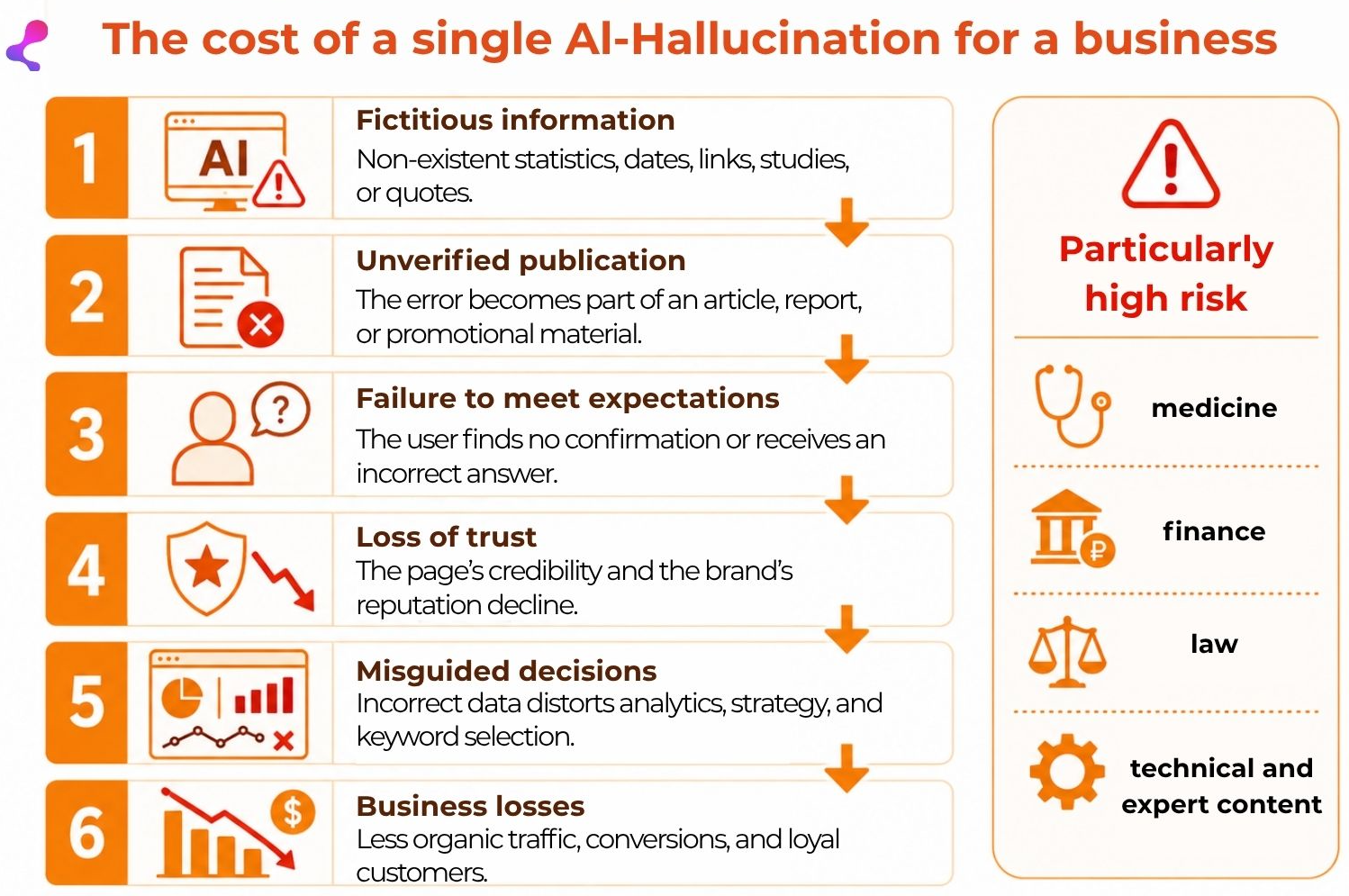
AI hallucinations resulting from the above causes do not go unnoticed by businesses. This is especially critical for SEO promotion and marketing, where information accuracy directly affects user trust, behavioral factors, and consequently, search ranking positions.
Key consequences for business:
- Loss of traffic and conversions. False information can drive visitors away if the content fails to meet expectations or raises doubts.
- Reputation risk. Even accidental errors can harm client loyalty and brand trust.
- Distorted analytics and strategy. Acting on inaccurate data leads to misguided tactics — wasted promotion budgets, misguided keyword targeting, etc.
- Negative impact on related fields. Content in healthcare and finance is particularly sensitive, where inaccuracies can be dangerous.
Effective ways to eliminate AI Hallucinations in SEO
Completely eradicating AI hallucinations is currently impossible, but their influence on SEO processes can be substantially reduced. It requires more than just improved prompts: a system must integrate content generation, fact verification, tool configuration, and human oversight into a unified workflow.
This is crucial when preparing expert articles, meta tags, analytical reports, and link building materials, where even one fabricated figure or nonexistent source can damage site credibility. Therefore, working with AI content should start not with publication but with a robust verification system reducing factual errors at every stage.
1. Fact-Check against primary sources
All dates, statistics, quotes, study names, algorithms, and services must undergo separate validation. In SEO content, verifying data via official search engine documentation, industry research, scientific publications, and analytics platforms is especially important.
Do not consider a statement true just because AI phrased it confidently and in detail. If the model mentions a specific study, algorithm update, or statistic, verify the source exists and the data matches the original.
2. Use AI for drafts, not as sole source
Generative AI excels at structuring information, brainstorming ideas, creating headline options, and preparing an initial draft. However, the final material should not be published without editorial and expert refinement.
The optimal workflow is: a specialist formulates the task and supplies verified data; AI generates the draft; SEO experts fact-check, verify search intent, terminology, logic, and alignment with promotion strategy. This speeds up content production without shifting responsibility for quality entirely onto AI.
3. Include Specific Constraints in Prompts
The more precise the task formulation, the less likely the model will fill gaps independently. Therefore, prompts should specify:
- target audience and promotion region;
- search intent;
- allowed sources;
- relevant timeframe;
- factual accuracy requirements;
- prohibition on fabricating data and links;
- response format if information is insufficient.
For example: «If there is not enough reliable data, do not invent an answer; instead, mark which facts require verification». Such phrasing doesn’t eliminate risk entirely but helps the model flag uncertainty more often.
4. Provide verified context to the model
Relying solely on the model’s general knowledge raises error risks, especially in niche or fast-changing subjects. A better approach is to supply AI with specific documents, tables, brand guidelines, research results, analytics exports, and links to approved sources.
For SEO tasks, this can include Google Search Console data, semantic core, technical audits, content plans, target page information, and internal linking rules. The higher the quality of input context, the less AI has to guess.
5. Break complex tasks into stages
Requests demanding simultaneous research, keyword selection, article writing, statistics citation, and linking pose multiple points of failure. It’s more effective to split work into consecutive steps:
- collect and verify source data;
- create structure;
- allocate keywords;
- draft text;
- fact-check and verify links;
- perform SEO editing;
- conduct final expert review.
Stepwise work simplifies quality control and helps quickly locate the stage where inaccuracies occur.
6. Train employees on AI best practices
Errors often arise not only from the model but also from user misconceptions. The team must understand that AI is neither a search engine, an expert, nor a guaranteed truthful database.
Explain which information types require mandatory verification, how to recognize fabricated links, why AI-generated text cannot be published without editing, and how to phrase queries correctly. Developing an internal policy with examples of acceptable and unacceptable AI use is advisable.
7. Customize models for specific SEO processes
When AI is regularly used by an agency or internal marketing team, generic configurations may be insufficient. The model should be adapted for project tasks: upload editorial policies, lists of forbidden phrases, source requirements, keyword handling rules, and checking templates.
You can create dedicated scenarios for recurring processes: meta tag generation, content brief preparation, semantic clustering, competitor page analysis, or draft creation. The more narrowly defined the task, the easier it is to impose constraints and control outcomes.
8. Verify links and resource mentions
AI often produces plausible but nonexistent URLs, publication titles, and author names. Before publishing, open every external link, check its content, publication date, and alignment with claims in the text.
This control is especially critical for link building and reputation management materials. Incorrect mentions can damage not only a single page but also brand trust. Proper external SEO optimization should rely on relevant platforms, real sources, and controlled publication quality.
9. Implement mandatory human oversight
The final publication decision must be made by a specialist familiar with the topic, business goals, and SEO requirements. Humans can assess not only factual accuracy but also hidden contradictions, irrelevant conclusions, misinterpretation of search intent, and misalignment with brand positioning.
In practice, dividing checks among roles is beneficial: the writer or editor handles structure and language, the SEO specialist manages semantics and search intent, and the subject matter expert verifies content accuracy. For critically important materials, an additional editorial review is recommended.
10. Create a unified quality checklist
To prevent checks from depending on individual diligence, standardize the verification process. Before publishing AI content, ensure:
- all facts are confirmed;
- links open correctly and lead to relevant pages;
- statistics are current;
- keywords are integrated naturally;
- text matches search intent;
- no repetitions or logical inconsistencies;
- conclusions do not exceed source data;
- human editing is complete.
This approach turns AI from an uncontrolled text generator into a reliable tool for the SEO team. Hallucinations cease to be a random threat, as each potential error passes multiple layers of review prior to publication.
Conclusion
Artificial intelligence is a powerful tool already transforming marketing and SEO today. Yet, the phenomenon of AI hallucinations reminds us that automation without oversight can lead to mistakes and losses. Understanding causes, skillful prompt work, quality data, and expert verification are key to harnessing AI successfully without the risk of «making up facts». Idea Digital Agency combines proven methodologies and innovation to help businesses of any scale maintain leadership in organic search and engage their audiences effectively.
FAQ
1. What is an AI hallucination?
An AI hallucination occurs when artificial intelligence generates information that is not based on real data or facts, but is fabricated or distorted.
2. Why does AI invent facts?
This arises from the probabilistic nature of models and limitations of training data. The model strives to always provide an answer, even if precise information is unavailable.
3. How can text hallucinations be recognized?
Signs include overly confident but unsupported content, contradictions with verified sources, and absence of references to real data.
4. Can AI completely avoid hallucinations?
No, but proper workflows, verification, and retraining substantially reduce their frequency.
5. How to minimize the impact of hallucinations on SEO?
Use human oversight, thorough fact-checking, customized tools, and train your team to work effectively with AI-generated content.


