
Google no longer just finds pages — it compiles the answer itself. Users ask a question, see an AI Overview at the top of the results, and get the information they need before even clicking. This changes the very mechanics of search for businesses: it’s no longer enough to just be in the top 10, since some customer decisions are made directly on Google without visiting the site.
Imagine you’ve invested years in content, analytics, and SEO promotion, but now you compete not only with other companies but also with answers generated by artificial intelligence. In this new reality, it’s crucial not just to rank well but to become the source Google trusts to include in the AI-powered results. Let’s examine what’s changing and what steps your business should take now — without panic, but also without expecting «the old ways» to work much longer.
What are AI Overviews and Google AI Mode? A simple explanation for businesses
To understand how to adapt to the new AI search, you need to get familiar with key concepts — Gemini, AI Overview, and Google AI Mode — which underpin the new algorithms.
AI Overviews are expanded answers Google generates by analyzing multiple sources to provide exactly the essence the user is looking for. For example, the query «how to choose a CRM for small business» can now return not just a list of sites but a synthesized overview of pros, cons, and prices with reviews of various products.
Google AI Mode is a search results mode where AI actively generates not only textual answers but also interactive elements: cards, checklists, tips. It makes search more dynamic and personalized. Thanks to this, AI Search goes beyond ordinary links and turns into a consultation tool directly on the results page.
Gemini is Google’s new AI platform that combines text and image processing capabilities. It enables the model to better understand queries, analyze tone and user intent, thereby enhancing relevance.
Working on client projects, we have repeatedly seen that those who promptly integrate these technologies into their content and SEO strategy gain an edge: their sites become sources of data that AI selects for generating overview blocks.
How AI changes Search marketing logic and user behavior
- Users now demand the fastest and most precise answers possible, often without clicking through (zero-click).
- Search is no longer just about keywords but about context and meaning.
- The role of featured snippets and overview cards, generated by AI and shown at the top, has grown.
- Users interact more with visual and interactive SERP elements, requiring a new way to present information.
- The importance of local and personalized search is increasing, pushing SEO specialists to work more with customer behavior data and preferences.
According to Ahrefs, AI Overviews significantly change how user attention is distributed. An analysis of 300,000 keywords showed that for queries with AI Overviews, the CTR for the first organic result drops on average by 34.5%. In other words, even the top-ranked link receives fewer clicks because part of the user’s needs are met by viewing the AI-generated answer.
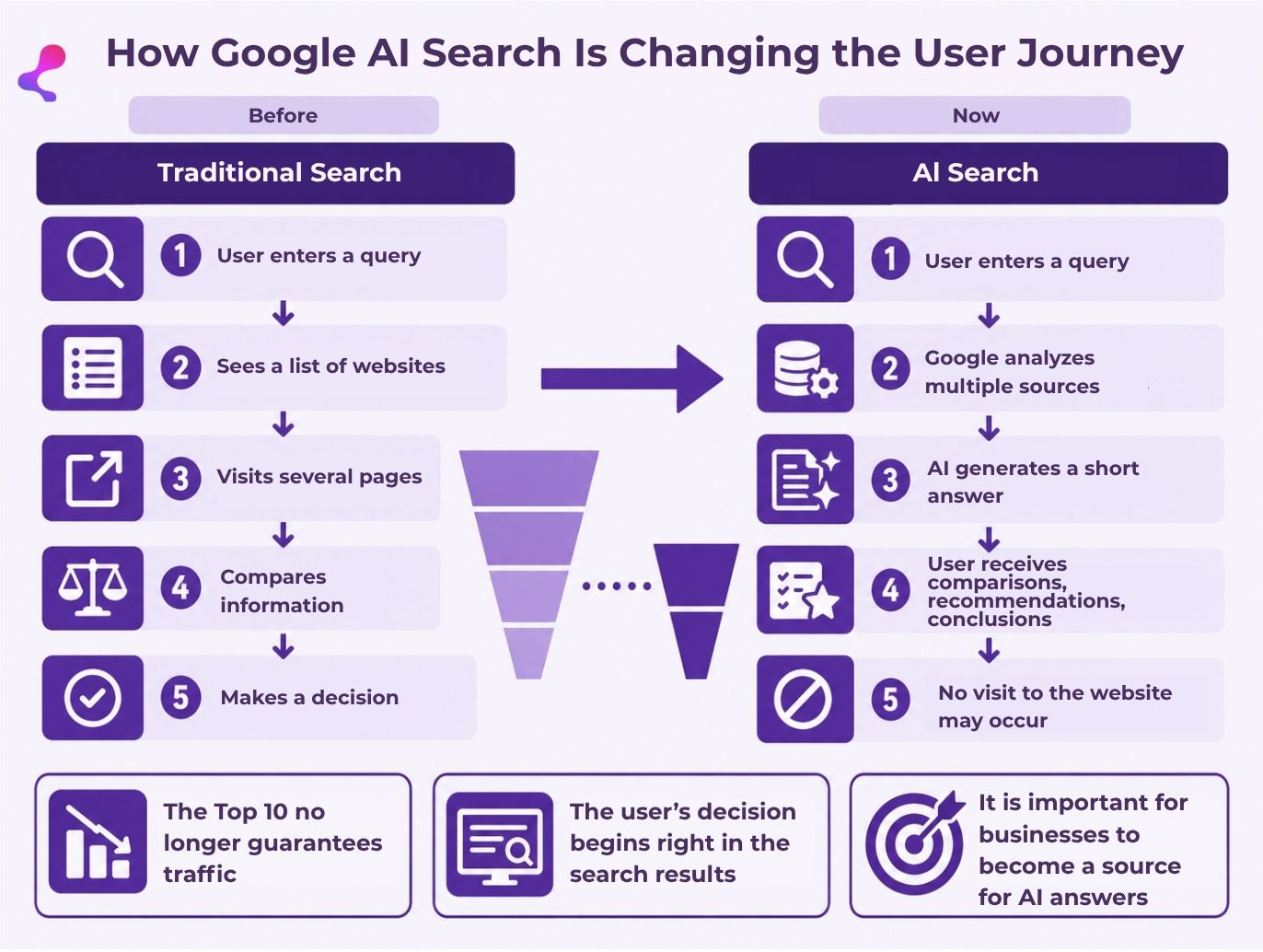
For businesses, this means a need to rethink SEO strategies — moving from classic tactics to a more intelligent approach focused on creating valuable content and a seamless user experience.
Practical steps to adapt your SEO strategy for the AI Era
To maintain positions during the transformation of search algorithms, a systematic approach to site and promotion strategy adaptation is crucial.
What to do right now:
- Analyze your content from AI’s perspective — create materials that directly answer user questions, structuring information into blocks and sections.
- Implement structured data (Schema.org) — ensure correct markup so AI can accurately interpret your content and display it in overview cards and rich snippets.
- Optimize your site for mobile devices and loading speed — modern AI favors fast, user-friendly experiences, which are ranking factors.
- Focus on a semantic core, reflecting not just keywords but thematic clusters and user intent.
- Regularly monitor behavioral metrics — track time on page, bounce rate, and user engagement with content.
These steps help not only to retain rankings but also to strengthen connections with customers and increase conversions.
How to optimize content for AI Overviews and Google AI
AI-friendly content is:
- Unique and well-structured text, easy to consume and logically divided (headings, lists, tables).
- Answers to specific user questions without unnecessary fluff.
- Use of terms and language close to the user’s own, including synonyms and lexical variations (LSI).
- Properly embedded data that allows the system to select your materials for AI-generated answers.
Technical requirements for successful AI Search promotion
Technical groundwork is critical for AI search to correctly interpret your content. Here is a checklist:
- Use Schema.org structured data in current formats.
- Verify your markup using Google Rich Results Test.
- Optimize page load speed (target less than 3 seconds).
- Responsive design and mobile usability.
- Proper use of meta tags and headings reflecting page content.
- Minimize technical errors (404, duplicate pages, broken links).
Without these, AI won’t be able to use your content effectively in featured snippets and overview blocks.
Risks and limitations of AI in SEO: what to beware of and how to protect your business
AI Search opens new opportunities but also makes SEO less predictable. The main risk isn’t AI itself but that Google increasingly takes over the first interaction with users. People might get answers right on the search page without visiting your site — even if your content helped create that answer. This means top rankings no longer guarantee the same traffic volume.
Another challenge is the flood of generic AI-generated content. If companies start publishing texts without expertise, facts, or real-world experience en masse, search engines will struggle to distinguish valuable materials from noise. Relying solely on automation is risky: your content should not just cover keywords but provide what standard AI answers don’t — practical insights, case studies, comparisons, expert opinions, and clear solutions.
There is also a technical side. Dependence on Google grows: changes in AI Overview logic, SERP format, or citation sources can quickly impact your site’s visibility. Traditional analytics no longer reveal the full picture: much interaction happens on the search page itself, while business only sees fewer clicks without understanding where attention was lost.
To protect yourself, build an SEO strategy broader than «just getting traffic from Google». Deeply analyze queries, monitor brand visibility in AI answers, strengthen content expertise, cultivate branded demand, and develop your own communication channels — email, social media, messengers, client databases. The more contact points your business has with the audience, the less it depends on a single search results change.
How to measure SEO effectiveness considering AI: new etrics and approaches
Traditional KPIs — ranking position and visitor counts — are becoming secondary. Now the focus is on:
- User engagement (time on site, depth of scroll, interaction with widgets).
- Zero-click traffic share — how many users get answers without clicking through.
- Presence in overview cards and AI Overviews — tracking visibility in new formats.
- Conversion actions — calls, requests, sales via the site.
This requires comprehensive dashboards integrating data from Google Analytics, Search Console, and AI-monitoring platforms.
Final emphasis: combining experience and technology to grow your business
At Idea Digital Agency, we believe that successful SEO today is the art of combining classic promotion expertise with cutting-edge AI technologies. Our approach is always focused on client pain points and goals, not on cookie-cutter solutions. We implement AI Search practices as they evolve and tailor strategies to specific niches and audiences.
If you want to develop a strategy that works now and delivers results soon, leverage Idea Digital Agency’s expertise. We’ll help you understand how your business can adapt to AI Search and remain a leader in your industry.


