
Key Takeaways
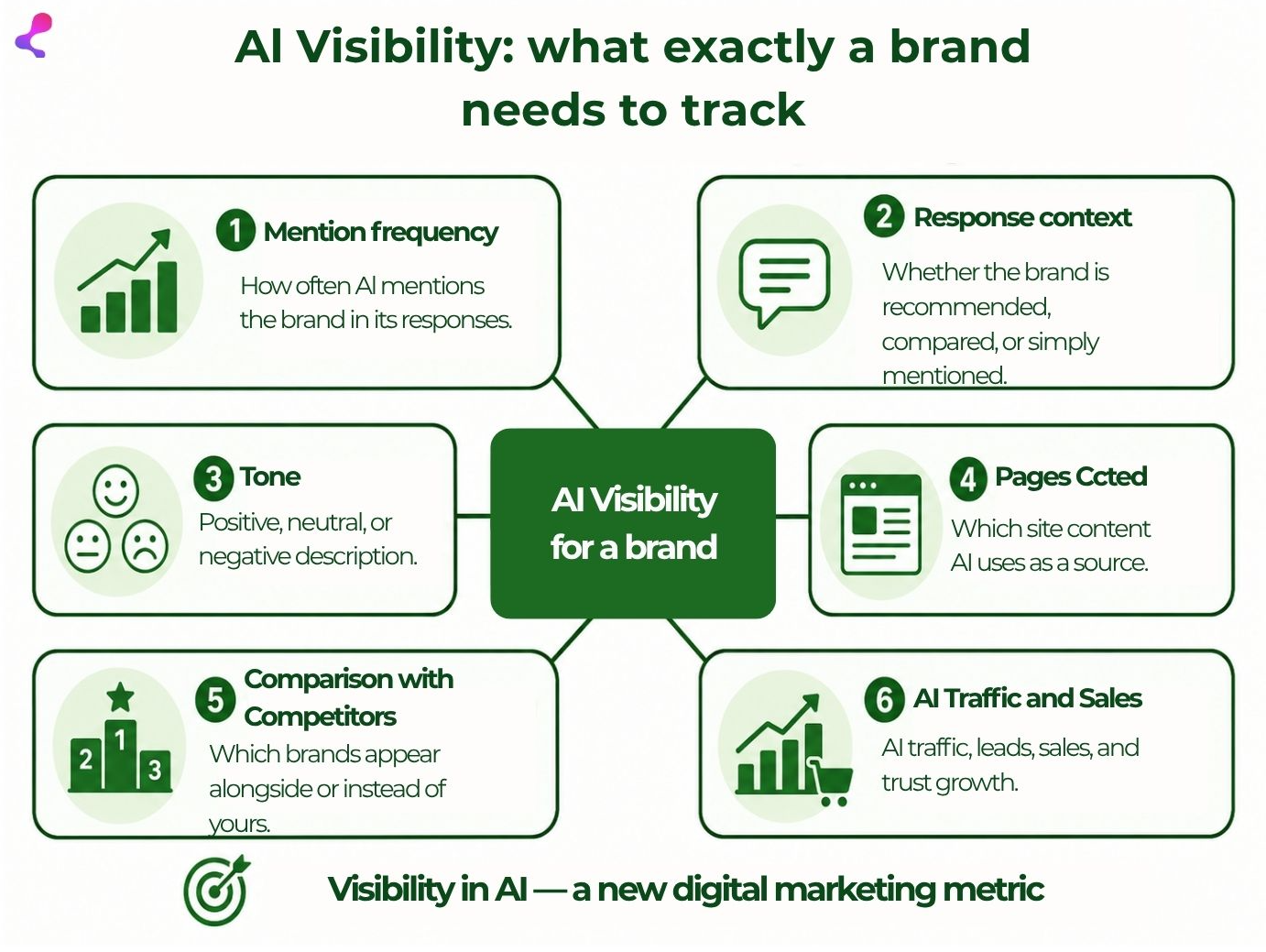
- AI visibility measures how often and in what way artificial intelligence (AI) mentions your brand in responses and recommendations.
- Monitoring brand mentions in AI is vital for reputation management, expanding reach, and increasing sales.
- While SEO traditionally evaluates page rankings and organic traffic, AI visibility reveals the role your brand plays in neural network answers: whether it is mentioned neutrally, compared to competitors, or actively recommended.
- Several tools on the market now track AI visibility, varying in features and scale.
- Analytics of AI mentions help develop effective strategies to improve brand positioning and grow targeted traffic.
- Successful AI SEO requires integrating brand mention monitoring with GEO optimization tools.
Just a few years ago, users searched for products, services, and companies exclusively via Google. Today, more people ask questions directly to ChatGPT, Gemini, Claude, and other AI systems. Instead of dozens of links, they receive ready-made answers with recommendations for specific brands, products, and service providers. Businesses face a new reality: it’s no longer enough to rank high in search results — it’s equally important to appear in neural network answers.
The problem is that most companies still do not track how exactly AI mentions their brand, which pages are cited, how accurately products are described, and in what context the company is recommended. As a result, businesses miss opportunities to influence a rapidly growing new source of traffic and demand.
In this article, we’ll explore what AI visibility is, why monitoring brand mentions has become a critical task for marketing and SEO website promotion, which tools help analyze your company’s presence in AI search, and how to use these insights to boost brand awareness, traffic, and sales.
What is AI Visibility and how can GEO affect it?
To understand AI visibility, let’s start with the basics.
AI SEO is an approach to optimizing websites and content to increase visibility in responses generated by large language models (LLM) and generative systems such as ChatGPT, Gemini, Claude, and others.
AI visibility indicates how often and in what context your brand, products, or content appear in AI-system answers. Unlike traditional search visibility, which focuses primarily on page rankings, AI visibility helps evaluate not only whether a brand is mentioned but also its function in the response: whether the system recommends the company, compares it to competitors, or merely lists it as an option.
Goals and benefits of monitoring brand mentions in AI
AI search is changing the customer journey. Therefore, businesses should understand not only their visibility in Google but also how ChatGPT, Gemini, and other AI systems describe the brand, cite content, and compare it with competitors.
High-quality and timely monitoring of brand mentions in AI helps promptly identify errors, strengthen presence in relevant answers, and make SEO decisions based on data rather than assumptions. It also addresses such tasks as:
- Reputation protection: AI can generate answers that mention reviews, data, or even incorrect information about your brand. Regular monitoring helps detect and correct negative mentions early, preventing potential crises.
- Increasing reach: AI often recommends goods and services as alternatives to competitors’. Tracking mentions in ChatGPT and other LLMs shows where and how your brand is positioned, providing insights to improve rankings.
- Competitive analysis: Monitoring AI Search visibility reveals how AI perceives competitors, enabling you to adjust promotion strategies and offer unique value.
- Business growth: The higher a brand’s visibility in generative search, the more organic AI-driven traffic a website attracts. This directly impacts the number of targeted inquiries and revenue.
In other words, monitoring AI brand mentions is not just another metric but an essential tool for strategic decision-making.
Top 7 Tools for monitoring AI Visibility and brand mentions in neural networks
The market for AI visibility monitoring tools is rapidly expanding. Solutions are already available that track mentions in ChatGPT, Gemini, Claude, and even Google AI Overviews — not just logging mentions but performing deep analyses of recommendations, assessing sales impact, and building competitive strategies. Let’s review the seven most notable services.
1. Alhena AI Visibility — AI Visibility monitoring linked to revenue
Alhena is a specialized product known for deep analysis of AI recommendations at the SKU level (individual product units) and the ability to correlate AI visibility metrics with actual company revenue. It automates control of ChatGPT, Gemini, Claude, and other AI recommendation accuracy, evaluates mention quality, and helps understand how AI traffic affects marketing ROI. Especially useful for e-commerce and brands with broad assortments aiming for steady growth through AI search visibility.
2. Otterly.AI — Affordable tool for small marketing teams
Otterly.AI is ideal for small and medium businesses beginning their AI SEO journey. The service supports monitoring mentions on popular AI platforms, analyzes brand Share of Voice, and conducts GEO audits with technical recommendations. Features include URL-based mention tracking, competitor comparison, and weekly data updates (which may limit its use for larger companies).
3. Nightwatch — Combining traditional SEO and AI Visibility
Nightwatch is a versatile tool enabling simultaneous tracking of AI responses and traditional search queries used by neural networks. It supports major LLMs (ChatGPT, Gemini, Claude, Google AI Overviews), analyzes sentiment of mentions, and allows exploration of why the brand appears in AI answers. Useful for companies focusing on both AI SEO and classic organic traffic.
4. Profound — Enterprise platform for AI Search Visibility analysis
Profound caters to large companies and enterprise segments. The service supports more than 10 AI systems, simulates customer journey scenarios, provides in-depth competitive analysis, and meets high corporate security standards. A key feature is integration of AI visibility with advanced client journey analytics.
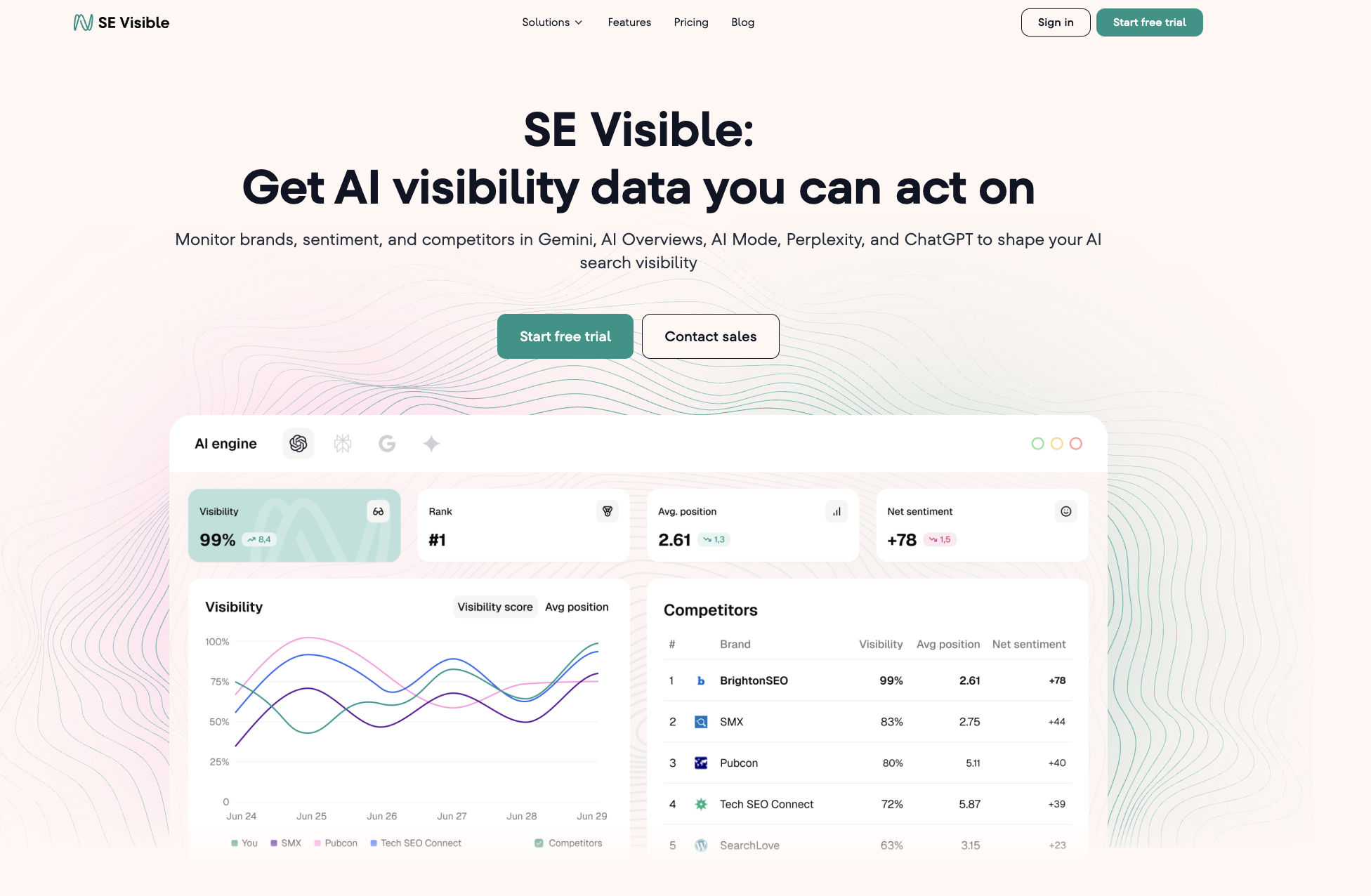
5. SE Ranking Visible — AI Visibility for agencies and client projects
Designed specifically for SEO agencies and clients managing multiple projects, this tool integrates into the SE Ranking Visible ecosystem, offers white-label reports, monitors mentions and citations in ChatGPT, Gemini, etc., and assists in creating content strategies based on AI visibility analysis. Its main advantage is the ease of managing multiple projects and transparent reporting.
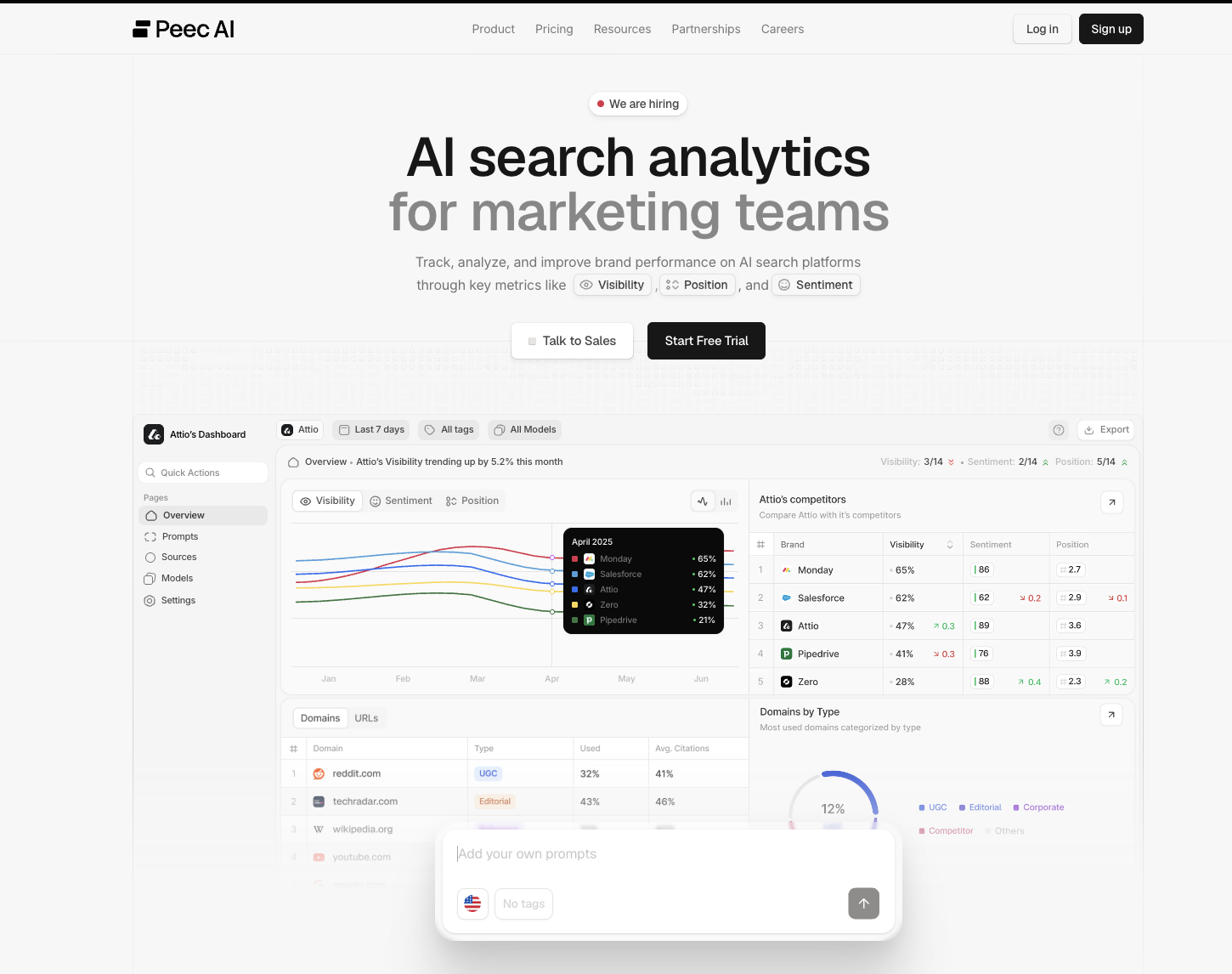
6. Peec AI — Quick brand perception analysis in AI responses
Peec AI features a simple interface focused on evaluating brand mention sentiment, identifying positive and negative associations. It supports monitoring ChatGPT and Gemini, analyzing keywords and context. Great for marketing teams wanting rapid insight into AI brand perception without requiring deep analytics.
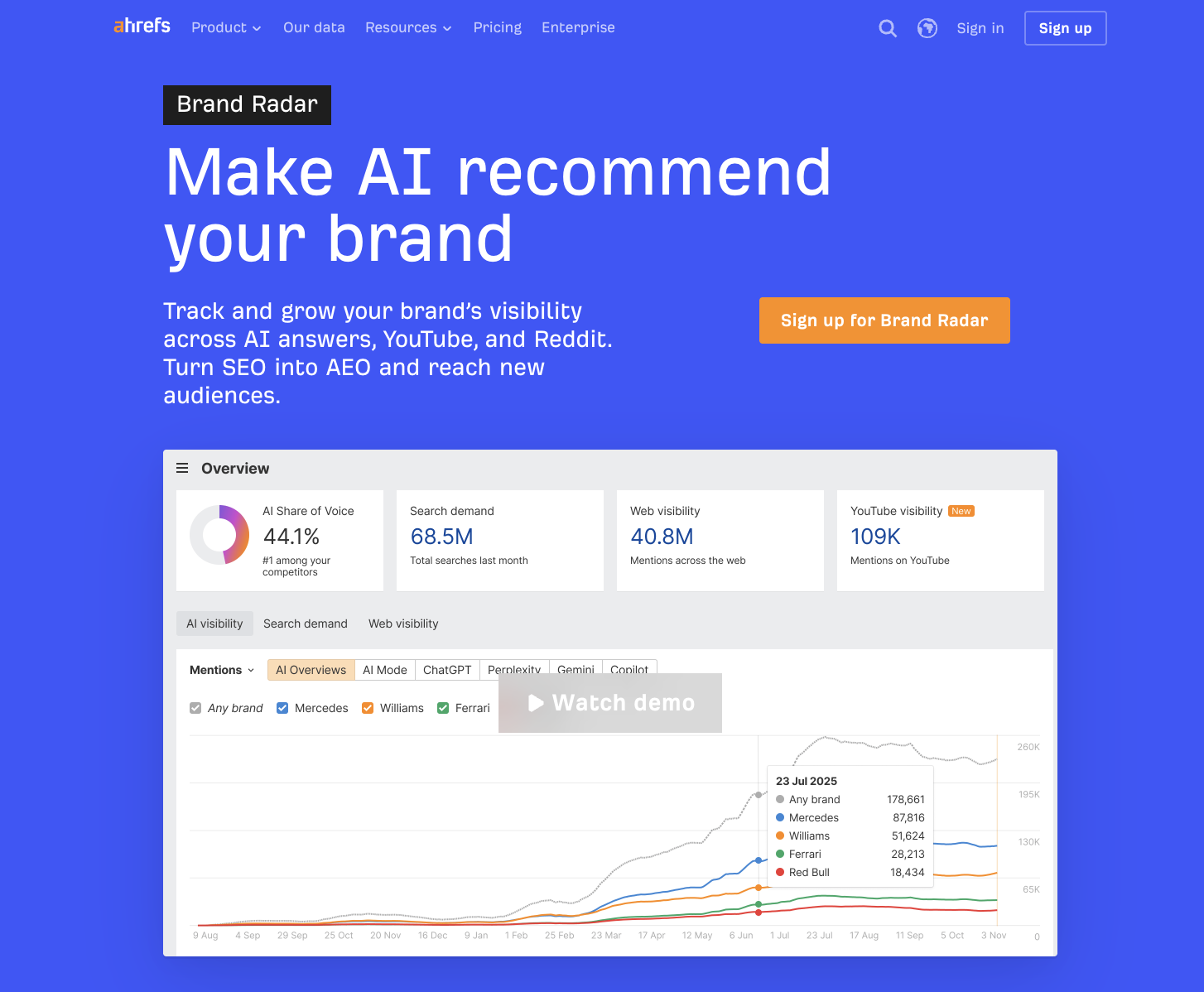
7. Ahrefs Brand Radar — AI Visibility within the familiar SEO ecosystem
Ahrefs Brand Radar expands possibilities by integrating AI visibility with SEO data (link analysis, content, keywords). It leverages an extensive database of over 239 million queries. Suitable for companies wishing to combine new AI visibility metrics with classic SEO KPIs in one dashboard.
Conclusion: Choose a tool based on your business goals. E-commerce sites will benefit from Alhena AI Visibility’s detailed recommendation tracking linked to sales. Agencies managing multiple projects will find SE Ranking Visible optimal. Large corporations with complex needs should consider Profound. Companies already familiar with Ahrefs will gain synergistic advantages using Brand Radar. This flexible approach not only monitors AI search brand mentions but also provides a solid foundation for developing GEO strategies and boosting visibility in generative AI systems.
How AI Visibility analytics helps shape an effective SEO strategy
AI visibility data reveals not only if the neural network mentions your brand but also why it does so in this specific context. This allows SEO teams to move from guesswork to concrete actions: which pages to strengthen, which topics to develop deeper, and where the brand is losing to competitors.
1. Understand current brand perception. Analyzing mentions, sentiment, and context shows what products, services, and advantages AI associates with your company and what it ignores or inaccurately describes.
2. Find queries with growth potential. If AI already mentions your brand within certain topics, these areas can be strengthened with content, expert materials, FAQs, and comparative reviews.
3. Close content gaps. If competitors appear more often in AI answers, analytics help identify what pages, wording, evidence, or expert signals your site lacks.
4. Align SEO with business goals. AI visibility helps assess whether the brand appears in responses likely to influence user decisions: recommendations, comparisons, solution lists, and commercial queries. This clarifies where the brand actively participates in decision-making and where more relevant content, expertise, or external mentions are needed.
Practical recommendations for tracking and optimizing GEO without specialized tools
Comprehensive platforms automate AI visibility monitoring, but even without specialized services, you can gather useful data on your company’s AI-search presence to support GEO strategy development by regularly analyzing accessible analytics, tracking popular neural network responses, and adapting content for generative search.
Analyze traffic from AI systems
First, determine whether your site receives visits from ChatGPT, Gemini, Claude, and other AI platforms. Use Google Analytics 4 to analyze traffic sources, referral traffic, and user behavior metrics such as engagement, conversions, and most visited pages.
Study sources frequently cited by neural networks
Generative models rely on authoritative publications, industry research, expert materials, and well-structured content. Analyze which sites and pages AI most often cites in your niche and compare their content to yours. This reveals trust signals, data, or expertise your resource may lack.
Implement GEO principles in content strategy
To increase the likelihood your brand appears in AI answers, create content easily interpretable by neural networks by:
- Publishing expert articles with clear conclusions and recommendations
- Adding FAQ blocks and answering popular user questions
- Using research, statistics, and real case studies
- Regularly updating outdated materials
- Strengthening E-E-A-T factors via author expertise and transparency
- Earning brand mentions on authoritative industry platforms
Monitor changes and adjust strategy
AI search evolves faster than traditional search engines, so monitoring must be regular. Even simple monthly checks of key queries, AI traffic analysis, and brand mention control help identify growth opportunities and measure GEO strategy effectiveness. Without specialized tools, businesses can still build a basic AI visibility monitoring system. The key is to regularly analyze data, track brand presence in neural network answers, and use insights to improve content, reputation, and generative search visibility.
Conclusions
User search behavior is rapidly shifting. Increasingly, people receive answers, recommendations, and comparisons not through classic search results but directly from ChatGPT, Gemini, Claude, and other AI systems. Brands can no longer rely solely on high Google rankings — it’s crucial to be visible where AI shapes user opinions and choices.
AI SEO helps companies adapt to this new reality. Regular AI visibility monitoring clarifies how neural networks perceive your brand, which pages and materials can be used as sources, by which queries your company is mentioned, and where opportunities for stronger presence exist. These data become a modern supplemental metric for SEO strategies and are useful for content, PR, brand marketing, and reputation management.
The main takeaway is simple: the sooner a business starts tracking its AI search visibility and applying GEO approaches, the higher the chances to secure strong positions in this new audience acquisition channel. Assess today how neural networks mention your brand, which topics are connected with your company, and what growth opportunities remain untapped. In the coming years, this will be a key competitive advantage in the digital landscape.
FAQ
1. How to check if my brand appears in ChatGPT and AI Overviews?
You can manually monitor by asking AI bots key questions, recording answers, and comparing brand mentions against competitors. For scale, it’s more convenient to use specialized services like Otterly.AI, Profound, Peec AI, SE Ranking AI Search Toolkit, Semrush AI Toolkit, or Ahrefs Brand Radar. These tools track brand mentions, citations, context of responses, and visibility trends across different AI platforms.
2. Which tools are best for small businesses?
Otterly.AI and Peec AI are suitable for small and medium businesses. They are easy to use, cost-effective, and provide sufficient data to get started with AI visibility.
3. How often should AI visibility analysis be performed?
At minimum once a month; with active campaigns, weekly is recommended. Rapid changes in the AI market require timely strategy adjustments.


