
Key Takeaways
- Search Everywhere Optimization (SEvO) is a comprehensive branding strategy that promotes your presence across all digital environments where users look for products, services, and expert answers.
- Traditional SEO focuses primarily on websites and search engines, whereas SEvO covers social networks, video platforms, marketplaces, and AI-powered search.
- A map of search environments helps identify exactly where your audience searches and makes decisions.
- Effective SEvO requires synchronization of SEO, content, PR, and SMM, adapting expert materials to various formats and platforms.
- Common pitfalls — spreading resources too thin, using identical content across channels, neglecting reputation management — lead to weak results.
Potential customers may first encounter your brand not on Google’s search results, but in a YouTube video, a Reddit discussion, a TikTok collection, a marketplace product card, or an AI assistant’s answer. By the time they visit your website, their opinion is already partially formed — based on content, reviews, comparisons, and recommendations found on other platforms.
That’s why ranking highly in Google alone is no longer enough. If a company is visible only in traditional search, it loses its audience at those crucial touchpoints where people research options, verify trustworthiness, and make purchase decisions.
Search Everywhere Optimization (SEvO) helps manage your brand’s presence across the entire search ecosystem: search engines, social networks, video services, marketplaces, AI search, and user communities. It is not a replacement for classic SEO but an evolution — from promoting a single website to systematically working across all channels that influence customer choice.
What is Search Everywhere Optimization and what does SEvO solve?
Search Everywhere Optimization (SEvO) is a modern SEO approach that expands traditional website optimization to the brand’s entire digital ecosystem. While classic SEO focuses on a site’s ranking in Google and other search engines, SEvO embraces every place where potential customers search for products, services, reviews, recommendations, and expert knowledge.
The primary goal of SEvO is to increase the number of audience touchpoints throughout the customer journey. This means the brand becomes visible not only in Google organic search but also across social media, video platforms like YouTube and TikTok, marketplaces, AI assistants, and professional communities.
SEvO enables you to:
- Expand audience reach and reduce dependence on search engine algorithm changes;
- Engage users at various decision stages — from problem awareness to purchase;
- Build trust through repeated exposure on diverse platforms;
- Boost branded demand via recommendations, social discussions, and AI-generated answers;
- Integrate SEO, content marketing, social media, and reputation management into a cohesive system.
How Search Everywhere SEO differs from traditional SEO
Criterion | Traditional SEO | Search Everywhere Optimization (SEvO) |
|---|---|---|
Optimization Object | Website | Entire digital ecosystem of the brand |
Channels | Search engines only | Multiple search engines + social networks, video platforms, marketplaces, AI search |
Formats | Website pages | Articles, videos, product cards, profiles, reviews, expert answers |
Metrics | Rankings, organic traffic | Overall visibility, mentions, multi-channel traffic, conversions |
User Journey | Single search-to-website click | Multiple touchpoints across various platforms during buyer journey |
It’s important to understand that SEvO complements, rather than replaces, classical SEO promotion of websites, enabling brands to be present where consumer attention is shaped today.
Why being only in organic search rankings is no longer enough
In reality, users today don’t just search on Google. Ranking in the top 5 results doesn’t guarantee broad visibility or conversions.
Customers may find competitors before ever seeing your site
Competitors active with video content (YouTube), marketplace reviews and ratings, expert articles, and social media discussions often gain an edge. For example, a product review video may appear before your webpage; marketplace ratings and testimonials (e.g., Amazon) can decisively influence choice. Even if your competitor’s website ranks lower in traditional search, their brand may look more familiar and trustworthy.
Brand visibility is part of building trust
Repeated encounters across social networks, food delivery apps, Google Maps, forums, and more create brand recognition and trust. Users are less hesitant to engage with companies visible everywhere they seek solutions — this functions as social proof.
Search visibility impacts more than just traffic
When a brand is present across channels, you gain not only website visitors but also:
- Branded demand — people think of you first when intending to buy;
- Recognition — easier to launch ads and attract loyal customers;
- Faster decision-making — shortening the path from search to purchase;
- Higher conversion rate — due to multi-channel loyalty reinforcement;
- Lower advertising costs — organic traffic and recommendations reduce paid channel dependence.
Where users search for brands, products, and services
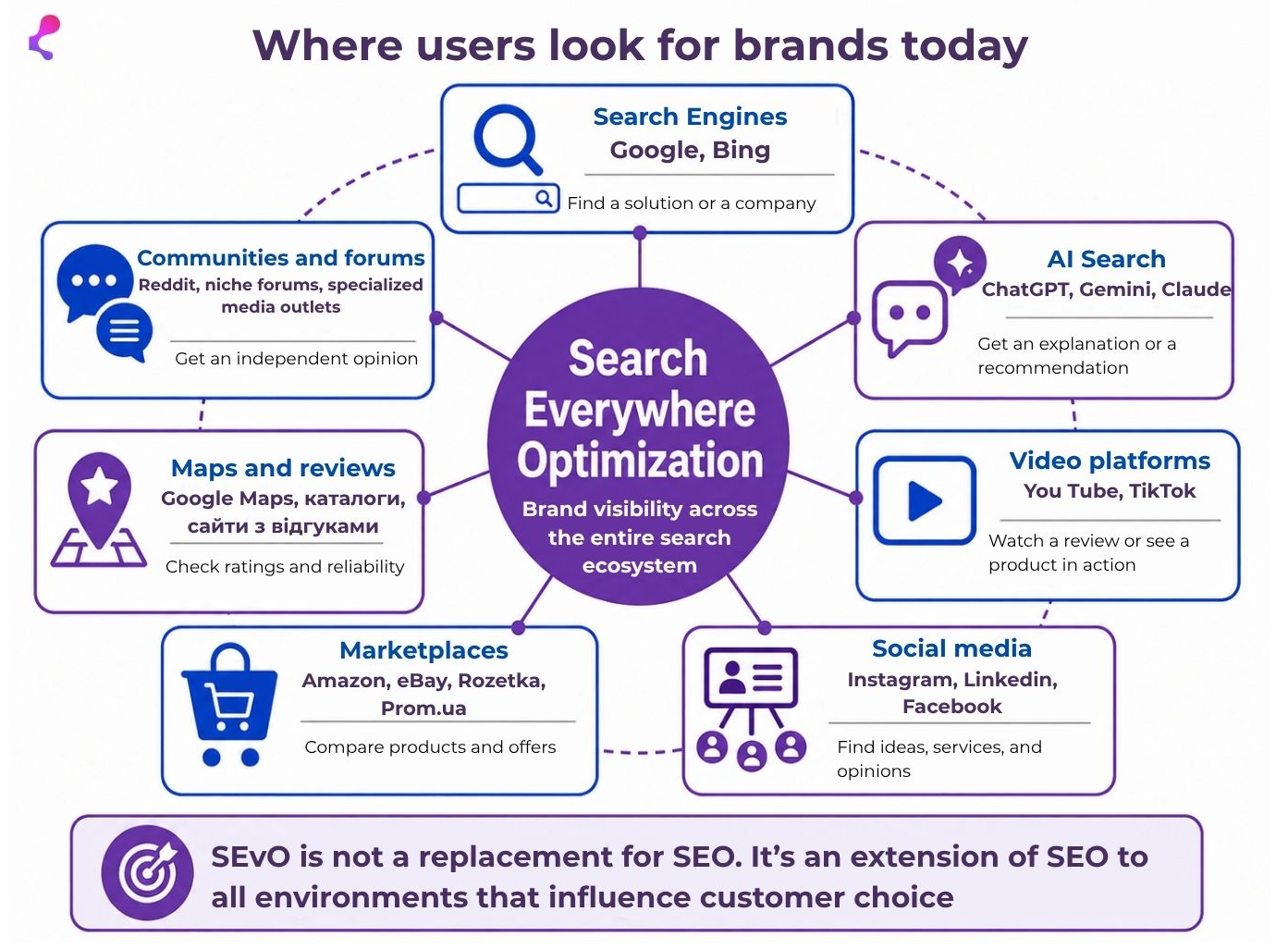
Digital space should be viewed as a map of search environments where each platform serves a specific function: finding solutions, comparing options, checking reviews, researching products, or finalizing purchases.
Traditional search engines
Google and Microsoft Bing remain central for informational and commercial queries—where initial product discovery, company comparisons, and website visits begin.
AI Search and generative assistants
Modern AI systems like ChatGPT, Gemini, and Claude are increasingly popular for personalized recommendations, detailed explanations, and solution options. To appear in AI-generated answers, use expert, clear, and well-structured content, earn mentions on authoritative sites, and build a strong reputation.
YouTube and other video platforms
Video is a powerful channel to demonstrate expertise, overcome objections, and showcase products in action. Video optimization involves working on the topic, title, description, chapters, and subtitles to rank in relevant search results and recommendations.
Social Networks
TikTok, Instagram, LinkedIn, and Facebook have long served as full-fledged discovery platforms for ideas, services, reviews, and professionals. It’s important to use the audience’s language and formats, pay attention to captions, comments, and user interactions — this is social search optimization.
Marketplaces and industry catalogs
Users on Rozetka, Prom.ua, Epicentr, or internationally on Amazon and eBay are often at the comparison and selection stage. Marketplace visibility depends on relevance and completeness of product listings, descriptions, images, ratings, and reviews — elements that help users evaluate offerings faster and increase purchase likelihood.
Maps, local services, and review platforms
For local businesses (stores, clinics, restaurants), visibility on Google Maps, directories, and review sites is critical. This attracts local customers and builds trust through ratings and prompt responses to feedback.
Professional communities, forums, and niche media
On Reddit and specialized forums people seek unbiased opinions, analyses, and practical advice. The brand’s role here is not direct advertising but participation in discussions, providing valuable information, and generating organic mentions.
How to identify where your audience is searching
SEvO does not require presence on every single platform simultaneously. Far more important is understanding where your potential customers actually seek information, compare options, and verify brands before engagement. Study real audience search scenarios and prioritize channels that most strongly affect decision-making and conversions.
Map the customer journey by examining how and where they search, what queries they use, where competitors are active, and which channels truly impact buying decisions.
Create a search journey map of your customer
Divide the customer journey into stages: need awareness, exploring solutions, company comparison, trust verification, and decision-making. For each stage, identify:
- The questions users ask;
- The preferred content format;
- The platforms where they look for answers.
For example, at the awareness stage, users often seek articles, short videos, or explanations. At the comparison stage, they access reviews, case studies, ratings, and service pages. Closer to action, they examine testimonials, discussions, company profiles, and proof of competence. This map helps determine where your brand should be present and what content format to use at each search touchpoint.
Analyze not just keywords but actual customer phrasing
Semantic analysis should include not only high-frequency SEO tool queries but also the actual language your audience uses. Semantic core collection should rely on search engine data plus real user scenarios.
Useful phrases come from autocomplete suggestions, website analytics, internal site search, sales conversations, customer feedback, comments, questions, and external discussions. This approach uncovers not only high-volume keywords but also low-frequency queries which often better reflect user intent and bring more targeted traffic.
Moreover, this analysis identifies conversational phrases, professional jargon, and unusual queries often missed in standard sets. For example, the phrase «searching optimization» might appear. While it’s worth noting, it should be used cautiously as it sounds unnatural and should not reduce content readability.
Evaluate competitors’ presence across search environments
Competitive analysis should go beyond website rankings on Google. Check which publications, videos, profiles, product cards, reviews, and third-party materials rank for competitor brand names and key niche queries.
Focus on platforms where competitors already have notable visibility but your brand is underrepresented — such as YouTube, TikTok, Reddit, marketplaces, industry catalogs, forums, or AI answers. This reveals both the level of competition and areas of opportunity to strengthen your brand’s presence faster.
Prioritize channels based on business impact, not popularity
Platform priority is determined not by popularity but by its ability to influence client choice and deliver measurable outcomes.
Evaluate each channel by five criteria: size of relevant audience, user proximity to purchase, competition level, resource availability, and measurability of results.
A high-reach channel is useless if the audience isn’t searching for your products or services there. Conversely, a niche platform with less traffic can yield higher-quality leads.
Therefore, SEvO must be aligned with specific business goals, not a generic list of trending platforms.
How Search Everywhere Optimization works in practice
SEvO is a sequential process. First, the brand defines core themes and ideas to shape its search image. These themes are then aligned with audience intent, adapted to platform-specific formats, and reinforced through publications, reviews, and expert mentions. Coordination between teams managing different channels is the final step.
Thanks to this sequence, articles, videos, social media posts, commercial pages, and external materials support overall brand visibility and accompany users through each decision stage.
Creating a unified brand semantic core
The initial step is building a semantic foundation for all materials. The brand must agree on positioning, expert topics, terminology, advantages, proofs of competence, and answers to key client questions.
The semantic core may include:
- Main areas of expertise;
- Audience problems the company solves;
- Working principles and methods;
- Arguments for the product or service;
- Case studies, data, and results;
- Responses to common doubts and objections.
Presentation may vary by platform, but core messages must remain consistent. Differing descriptions of specialization or benefits across website, social media, and external publications make it harder for users to form a coherent brand perception.
After semantic core approval, identify the search situations and user expectations where these messages will surface.
Adapting content to search intent
One expert topic may address multiple types of search intent:
- Informational — understanding the problem;
- Comparative — choosing between methods, products, or suppliers;
- Commercial — looking for a service or product;
- Navigational — going to a specific company, page, or profile;
- Reputational — verifying reviews, experience, and reliability.
Each intent requires a distinct focus. Informational queries need explanations and practical tips; comparative searches require criteria, differences, and limitations; commercial intent should lead to a clear offer; reputational queries demand cases, testimonials, and independent confirmation.
Content format depends on both intent and platform. An informational query on the website suits an article or guide; commercial, a service page with offers and results. On YouTube, the topic can be a review or tutorial; on TikTok, a short explanation; on Reddit, a detailed response in a relevant discussion.
When intent and suitable formats are defined, central expert content can be broken down into individual pieces for different channels.
Repurposing expert content across channels
A core piece — article, study, case, webinar, or detailed tutorial — serves as the basis for multiple independent publications, each addressing a specific task on its platform.
For example, a detailed article can be repurposed into:
- a series of short videos;
- a checklist;
- a LinkedIn post;
- a forum answer;
- an infographic;
- a presentation;
- a FAQ;
- a service page foundation.
During repackaging, the main idea, arguments, and facts remain intact, but volume, structure, and delivery style change. YouTube videos require scripts, visuals, and engagement; social media needs brief theses and quickly perceived benefits; forums require direct, informative answers; commercial pages link client problems with service benefits and calls to action.
Adapted content creates its own contact points, but trust can only be strengthened if confirmed beyond owned media.
Generating external authority signals
External signals demonstrate that other market participants, clients, and relevant resources recognize the brand’s competence. These include:
- Expert comments;
- Digital PR;
- Partner materials;
- Industry publications;
- Verified-result case studies;
- Links from relevant sites;
- Customer reviews;
- Independent mentions and discussions.
Such content helps users evaluate company experience and reliability, while search and AI systems gain additional sources linking the brand with topics, products, and expertise.
The most valuable signals are substantive mentions in relevant context — expert commentary with specific conclusions, case studies showing measurable results, or detailed reviews — stronger than mere brand name placement.
Creating these signals involves multiple marketing areas, so different teams must collaborate within a unified system.
Coordinating SEO, content, PR, SMM, and reputation management
SEvO implementation requires coordination of specialists responsible for different search environments. The SEO team analyzes demand and selects priority queries. The content team turns them into expert materials. SMM adapts topics for social platforms. PR secures external coverage and mentions. Reputation management handles reviews, discussions, and audience feedback.
Successful collaboration requires:
- A shared semantic core;
- Unified terminology;
- A map of search intents;
- A common content plan;
- Access to research data;
- Agreed performance metrics.
With this approach, one priority query is revealed sequentially in an article, video, social media post, expert comment, case study, and commercial page. Each piece serves a unique function, and together all channels build brand awareness, trust, and selection likelihood.
How to optimize content for AI Search
AI optimization begins with the quality and accessibility of information. Keyword stuffing, hidden model instructions, or other attempts to manipulate generation do not build sustainable visibility. Content must help AI accurately identify the topic, extract relevant facts, and associate them with the brand’s competencies.
Work on four key areas:
- Provide clear and easily extractable answers. Key definitions, conclusions, and recommendations should be straightforward, without long introductions or ambiguous language. It’s easier to present information via step-by-step instructions, comparisons, tables, lists, and Q&A blocks. Each key idea should retain meaning even if AI extracts it in isolation.
- Support expertise with facts and experience. General claims of professionalism are insufficient for AI to consider the source authoritative. Stronger signals include case studies with measurable outcomes, methodology descriptions, practical examples, author credentials, update dates, and transparent company information. Statements should be backed by data, sources, or verifiable experience.
- Build a stable brand information environment. Company data should be consistently confirmed across varied resources — industry catalogs, media, partner sites, professional profiles, reviews, niche publications, and independent mentions. Matching brand name, specialization, services, experts, and key advantages helps AI better recognize the brand and link it to specific topics.
- Track mentions alongside clicks. Users might get a recommendation in an AI answer and later find the company independently without clicking the link. Thus, measuring results should include brand mention frequency, wording of recommendations, cited sources, accuracy of information, and competitor presence. Additionally, monitor branded query trends, direct visits, and inquiries citing AI as the discovery source.
This optimization increases the chances that AI systems accurately interpret your brand’s materials, use them as trusted references, and include your brand in recommendations.
Common mistakes that undermine search everywhere strategy results
SEvO effectiveness depends not on the number of platforms but on the quality of their selection, content coherence, and connection to business metrics. In practice, the strategy often fails due to:
- Trying to be everywhere at once. Spreading budget and team across dozens of channels leads to infrequent publishing, superficial content, and no notable impact on any platform. At the start, it’s wiser to focus on two or three search environments most used by your target audience and that most influence purchase decisions.
- Publishing identical content on all platforms. YouTube, TikTok, Reddit, marketplaces, and search engines differ in formats, algorithms, and user expectations. Brand themes and positions should be consistent, but structure, volume, presentation style, and calls to action must be tailored to each channel.
- Focusing solely on reach and rankings. High positions, views, and impressions confirm visibility but don’t show commercial value. Activity must be linked to visits, branded demand growth, inquiries, sales, and lead quality/cost. For channels lacking direct conversions, consider associated interactions and follow-up brand queries.
- Ignoring reviews and external reputation. A quality website can’t compensate for low ratings, unresolved negative feedback, or inconsistent information on third-party resources. Users verify companies through reviews, maps, directories, social profiles, and discussions, so reputation platforms must be regularly monitored, updated, and actively managed.
- Expecting quick results without systematic work. Visibility in diverse search environments builds gradually. Growth requires regular publishing, content updates, accumulating reviews, increasing external mentions, and strengthening thematic expertise. One-off campaigns may generate short-term reach but won’t create sustainable brand presence.
A step-by-step plan for implementing Search Everywhere Optimization
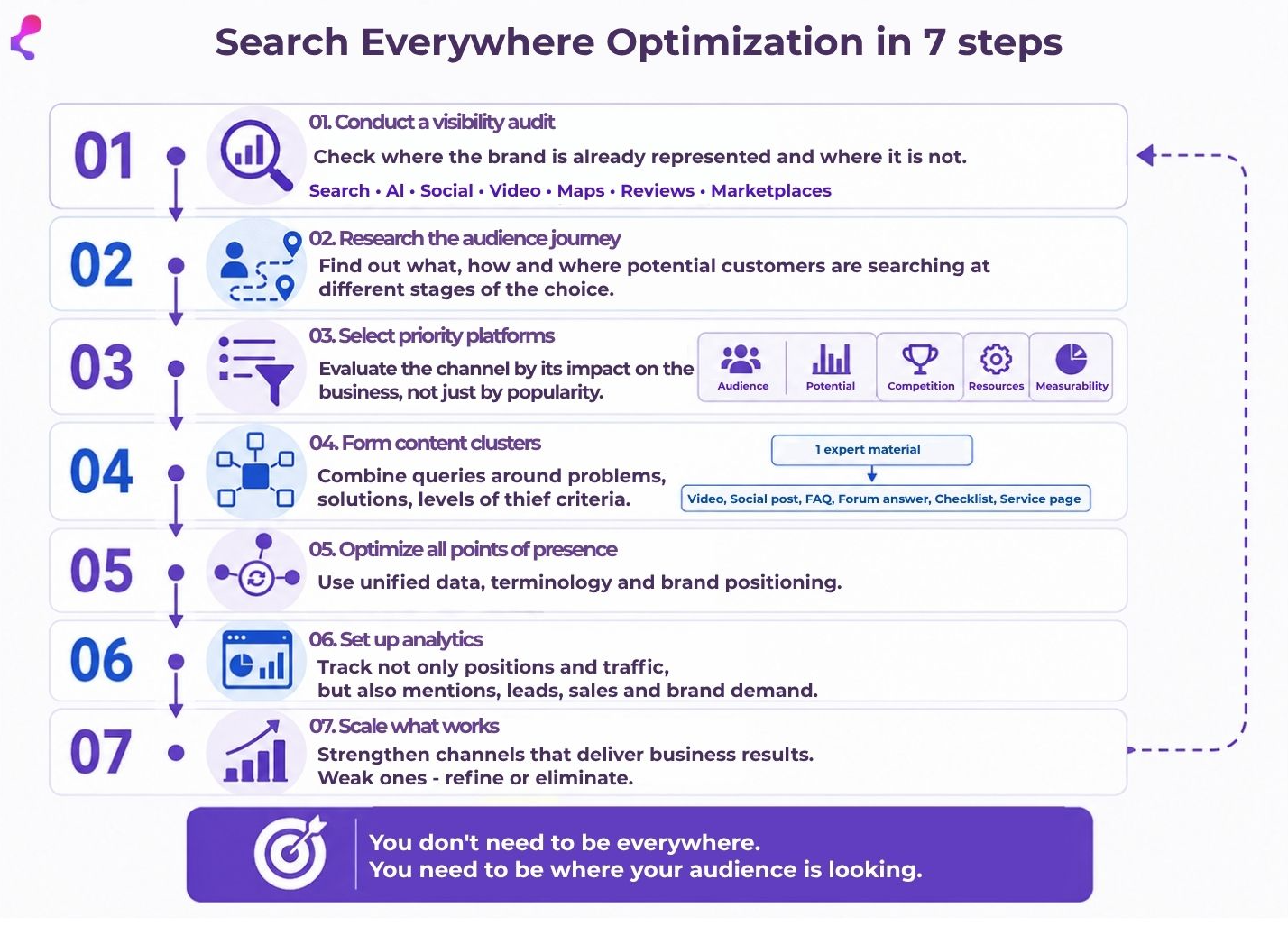
SEvO does not require launching dozens of channels at once. A phased approach is more effective: first audit current visibility, then identify priority directions, prepare content, and finally scale the strategy based on results.
- Audit current search visibility. Assess brand representation across all search environments: website, search results, maps, social networks, YouTube and other video platforms, marketplaces, directories, review sites, AI answers, and external mentions. This reveals platforms where the brand already attracts attention and gaps to address.
- Research audience search scenarios. Analyze questions users have at each decision stage, query wording, and where they seek answers. Use autocomplete suggestions, web analytics, internal site search, sales team feedback, reviews, comments, and community discussions. The output should be a map of audience search behavior, not just a keyword list.
- Select priority platforms. Not all channels equally influence client acquisition. Evaluate audience size, commercial potential, competition, resources needed, and measurability. Initially choose a few platforms with the highest impact for your business.
- Form content clusters. Group queries by themes, not just keywords. Clusters may focus on client problems, solutions, product/service comparisons, common objections, and choice criteria. Define a main content piece per cluster — such as an article or study — and then create additional formats for different platforms: videos, social posts, forum answers, checklists, FAQs, or service pages.
- Optimize owned and external platforms. Update all brand touchpoints with consistent terminology, current data, and unified positioning. Check website structure, commercial pages, social profiles, marketplace listings, service descriptions, videos, images, catalog entries, reviews, and external info.
- Set up analytics and KPIs. Record baseline metrics before launching. Define channel-specific KPIs: visibility by queries, brand mentions, views, visits, engagement, leads, sales, or branded demand growth. Regular analysis helps identify successful tactics and adjust less effective areas.
- Scale business-impacting solutions. Based on data, increase investments in platforms and formats generating quality traffic, enhancing brand recognition, and driving inquiries or sales. Improve or test new hypotheses on low-performing channels or remove them. This approach expands SEvO gradually without wasting budget and resources.
Search Everywhere Optimization is an Evolution, not a replacement of SEO
Search engine promotion remains vital but extends beyond classic results pages. Brands still need technically sound websites, strong structure, relevant content, and steady organic rankings. However, full visibility now requires presence across social media, video services, marketplaces, AI search, review platforms, and user communities.
Winners are companies that understand their audience’s real journey and select channels by their influence on customer decisions. Trying to cover all platforms simultaneously usually causes resource dilution. Consistent work with priority search environments, adapted content, and unified positioning yields more sustainable results.


